 spitball
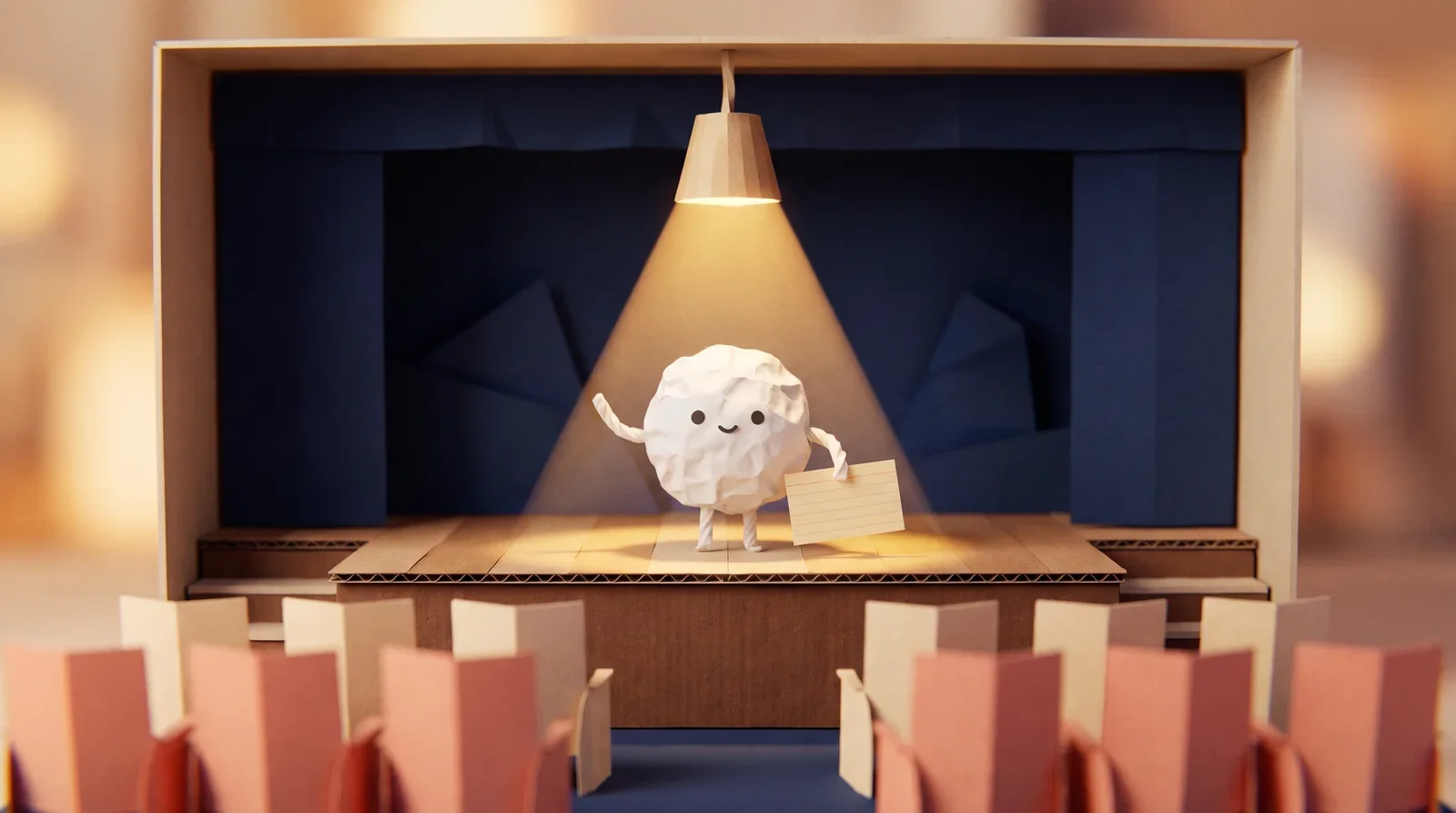
THE SHORT VERSION
What to take away
- Memorize the opening, the close and anything that must be exact word for word; learn the rest as sections, each with one key line.
- Rehearse out loud, standing and moving as you will on the day; in theater-dialogue studies, lines practiced with movement were recalled better.
- Record each section and replay it in dead time, pausing to say the next line before you press play.
- Test yourself from key lines instead of rereading, and sleep between sessions; split practice over several days.
- Do one full run-through in front of a person before the day, and rehearse what you'll do if you go blank.
WATCH THE IDEA
Learn a speech in four rehearsal moves
A short illustrated clip with four rehearsal moves for memorizing a speech: rehearse out loud on your feet; cut the script into sections with one key line each and place them on a familiar route; record and replay each section, saying the next line first; and sleep between sessions before one run-through for a real person.
Read the video transcript
This video has no narration. Pip, the Spitball paper-ball character, steps into a spotlight on a small wooden stage and gestures as if rehearsing to rows of empty paper seats. Next, paper scissors cut a long paper scroll into pastel strips while Pip hops along beside them. Then Pip walks past a small paper house with a key at the door and an umbrella inside, toward a paper kitchen with a teapot. Finally, Pip listens through paper headphones on a small stage, sets them down and opens its arms toward the audience. Captions: Learning a speech? Rehearse it out loud, on your feet. Cut the script into short sections, one key line each. Give each section a spot on a route you know. Record each section. Replay it, and say the next line first. Sleep between sessions. Test yourself in the morning. Then do one run-through for a real person.
To memorize a speech, learn its structure before its words. Split it into short sections, rehearse each one out loud on your feet, record it and replay it, and test yourself without the script. Spread sessions over several days with sleep in between, and memorize only the opening and closing word for word.
Memorizing a speech means being able to deliver it in order, without reading, while still sounding like you're talking to people. This guide turns memory research into a five-day rehearsal plan for a toast, a talk or a presentation. Spitball is our app, so where we mention it we've kept to what it actually does.
Research claims link to the original papers; we checked each DOI on October 27, 2026. Apple steps come from Apple's iPhone User Guide for iOS 27, checked the same day. The plan itself is our synthesis, not a tested method.
Should you memorize a speech word for word?
Usually not. We suggest memorizing three things exactly and the rest by meaning:
- Your first two or three sentences. The opening is where nerves are worst, so a fixed script gets you moving.
- Your last two or three sentences. A clean ending stops you trailing off.
- Anything that has to be exact. A quote, a figure, a name, a legal line or a promise.
Everything in between, learn as a sequence of points, each with one key line you could say from memory. If you lose a word, you can say the point another way. If you've memorized every word and lose one, the next sentence can go with it.
Public-speaking courses often call this extemporaneous speaking: prepared and rehearsed, but delivered from a keyword outline rather than a memorized script.
Some research fits this choice. In two experiments, people who were coached to work through a script by speaking it aloud while moving recalled more of it than people who deliberately set out to memorize the same material (Noice & Noice, 2001, Memory & Cognition). Treat it as a point in favor of rehearsing over rote drilling, not proof that rote learning fails. That was theater dialogue in a lab, not a speech.
Exceptions exist. For a short toast of a minute or two, or a speech where exact wording matters, such as a eulogy you'll read from, learn the whole text or keep it in your hand. For a wedding or best man speech of three to five minutes, the five-day plan below fits; learn your opening and the toast itself word for word. Holding notes is not a failure.
How do you break a speech into chunks?
Turn the script into an outline of sections, each one idea long, then give each section a key line. We suggest:
- Read the whole speech out loud once, timing it. You'll learn its length and where it naturally breaks.
- Mark the sections. Aim for sections you can say in one or two minutes. Many speeches split into an opening, three to five body sections and a close.
- Write one key line per section. A short sentence that, if you remember it, pulls the rest of the section with it, such as "The day the van broke down in Ohio."
- Write the transitions. The sentence that moves you from one section to the next is an easy place to lose your way, so treat each one as its own item to learn.
- Put the key lines on one card. That card is your keyword outline and your safety net on the day.
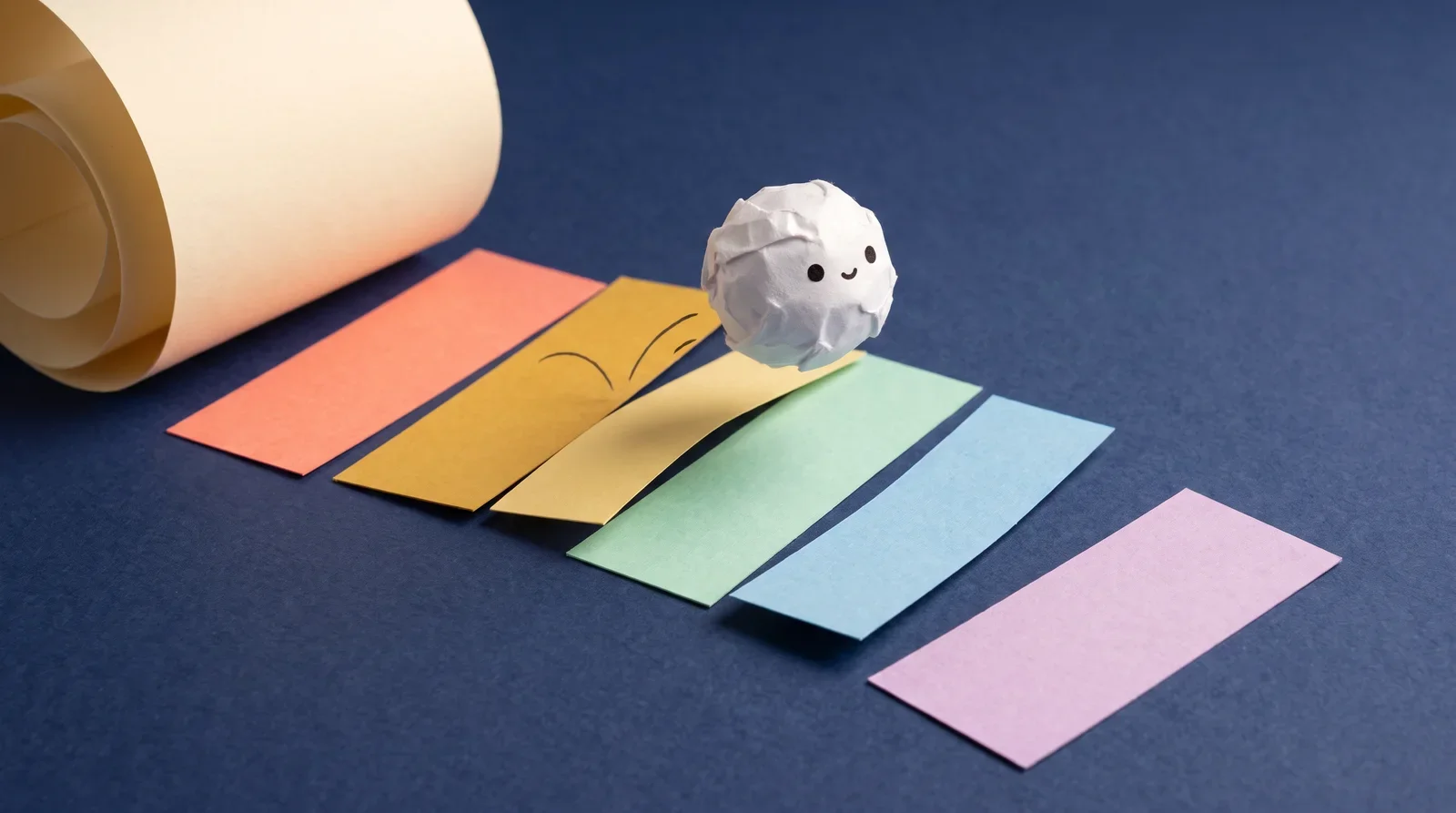
Learn the sections one at a time, but don't only start from the top. If you always begin at the opening, the opening gets dozens of repetitions and the last section gets a few. Start some sessions at section three or at the close, so every part gets its share.
Short sections also make recording easier. A section you can say in two minutes is a recording you'll actually replay.
Why should you rehearse a speech out loud and on your feet?
Because the version of the speech you practice is the version you'll remember. In lab studies, words people say aloud are often remembered better than words they read silently; we cover that research, known as the production effect, and its limits in what happens to memory when you say words aloud. The advantage is clearest when people say some words aloud and read others silently. When one group says every word aloud and another reads silently, which is closer to rehearsing a speech, a meta-analysis still found a benefit, but a moderate one (Fawcett, 2013, Acta Psychologica). Movement may help too.
- Non-actors. In the 2001 experiments above, people who read a script aloud while moving as a director instructed retained more than people who only spoke the lines. Within the moving group, speeches delivered while moving were remembered better than speeches the same person delivered standing in one place (Noice & Noice, 2001).
- Professional actors. In a study with actors, dialogue performed while moving from place to place was better recalled than dialogue performed in one spot, even when recall was spoken only. The benefit was still found after a five-month delay (Noice, Noice & Kennedy, 2000, Memory).
In practice, stand up, use the gestures you plan to use, and move where you'll move on the day: step forward for the story, turn toward the slide. Rehearse at full volume at least once per session. Mumbling it at your desk is a different task from saying it to a room.
These studies used theater dialogue, not speeches or presentations. We found no research testing movement during speech rehearsal specifically.
Does listening to a recording of yourself help you memorize a speech?
It can help, but saying the speech yourself is likely to help more than listening. In one word-list experiment, people remembered words they read aloud best, then words they heard in a recording of their own voice made earlier, then words read by someone else (Forrin & MacLeod, 2018, Memory). That is a lab test of single words, not a speech, but it suggests a recording of your own voice is a reasonable thing to replay.
So use replays for the time you can't rehearse aloud, such as a walk, a commute or the washing up, and use the rest for speaking. Some ways to make replays count:
- Record one section per recording. A short file is easy to replay and easy to name.
- Pause and say what comes next. Stop the recording at a transition and say the next line before you press play. That turns listening into a recall test.
- Slow it down while you're learning. In Voice Memos, tap a recording, tap the More button, then Options, and drag the speed slider toward the tortoise. Apple says the setting doesn't change the recording and stays with that recording (Apple: Play a recording in Voice Memos).
- Use skip back. Voice Memos has a button that skips back 15 seconds, handy for repeating the line you keep missing (Apple).
If you're collecting several takes, put them in their own Voice Memos folder or mark them as Favorites while you rehearse; our guide to organizing voice memos has the steps.
How do you remember the order of your points?
Use a memory palace, also called the method of loci. Picture a route you know, such as your front door, hall, kitchen and living room, and put one vivid object for each section at each spot. To give the speech, walk the route in your head.

For a speech, that might be:
- Front door: a giant key, for the opening story about the first day.
- Hall: an umbrella, for the section on what went wrong.
- Kitchen: a teapot, for the section on the people who helped.
- Living room: a lamp, for the lesson and the close.
The technique has been studied mainly for word lists. In one experiment, people recalled 10 lists of 11 unrelated words in order, using either the traditional method (a place they knew well) or a modified version built on a virtual environment they had studied only briefly. Both helped compared with people given no instructions, and the virtual version worked about as well as the familiar one, at least for people new to the technique (Legge et al., 2012, Acta Psychologica).
For a speech, four or five rooms is enough. We found no research testing the method on full speeches, so treat it as a way to hold the order of your sections, not the wording within them.
How do you test yourself on a speech without the script?
Put the script face down, look at one key line, and say that section from memory. Then check it against the script or your recording and mark what you missed. Repeat with the next key line.
This is retrieval practice: pulling the material out of memory instead of rereading it. It's one of the better-studied learning techniques, and we cover the research in testing yourself instead of rereading. For a speech, a few adjustments help:
- Test transitions on their own. Say the last line of a section, then the first line of the next. That's the join most likely to break.
- Test from a random section. Pick a key line off the card at random and start there, because on the day you might lose your place anywhere.
- Keep a misses list. Every word or point you drop goes on it. Your next session starts with that list, not the opening.
- Stop rereading once you can get through it. After the first day, the script is for checking, not reading.
When you can get through every section from its key line with only small wording changes, you've memorized the speech. Now you're rehearsing the delivery.
How far ahead should you start memorizing a speech?
Several days ahead if you can, with at least one night's sleep between learning a section and practicing it again. Cramming everything into one long session the day before gives you fewer chances to sleep on it.
A study of sleep and relearning supports splitting sessions around sleep. Forty participants practiced foreign-language vocabulary until they got every item right, in two sessions 12 hours apart. Half learned in the morning and relearned that evening; half learned in the evening, slept, and relearned the next morning. The group that slept between sessions needed about half as much practice to relearn the words as the group that stayed awake, and remembered them better a week and six months later (Mazza et al., 2016, Psychological Science). The two groups also practiced at different times of day, so sleep isn't the only difference between them. Across many studies, sleep's benefit for memory is real but smaller than that: a 2021 meta-analysis of 271 samples found a moderate overall benefit, which shrank but stayed significant after accounting for possible selective reporting. The benefit was larger for material studied more than once and for a normal night's sleep (Berres & Erdfelder, 2021, Psychological Bulletin).
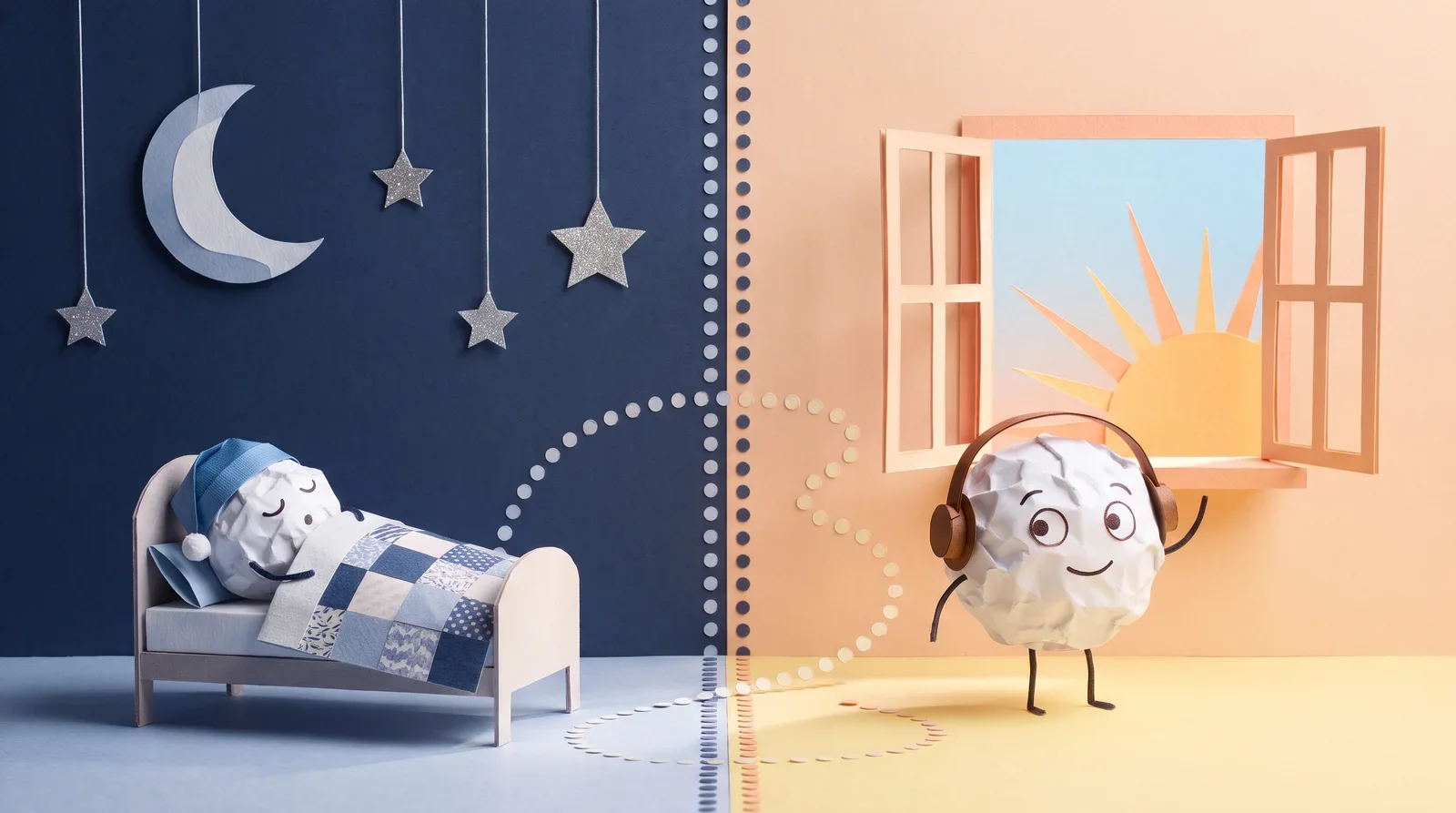
That was vocabulary, not a speech, but it maps neatly onto rehearsal: learn a section in the evening, then test yourself on it the next morning before adding a new one. If you only have a day, still split your practice into an evening session and a morning session rather than one long block.
What does a five-day plan to memorize a speech look like?
Here's our suggested plan for a 5 to 10 minute speech, with two short sessions a day. Squeeze it into three days if you need to, by doubling up the middle.
- Day 1 (evening). Read the speech aloud once, timed. Split it into sections, write the key lines and transitions, and make your card. Learn the opening and record it.
- Day 2. Morning: say the opening from memory, then check. Evening: learn the first one or two body sections on your feet, record each, and test the transitions.
- Day 3. Morning: test yesterday's sections from their key lines. Evening: learn the remaining sections and the close. Build your memory palace route.
- Day 4. Morning: walk the route in your head, then say the whole speech from the card. Evening: start from random sections and work through your misses list. Replay recordings in any dead time.
- Day 5. Do one full run-through in front of a person, standing up, at full volume. Then stop. Do a final light run the morning of the speech.
If your speech is longer than about 10 minutes, or you have less time, keep the opening and close scripted and speak the middle from your card. A clear structure delivered from notes beats a memorized script you're anxious about losing.
Can you memorize a speech the night before?
You can get close, if you aim for the structure rather than every word. Here's how we'd use one evening and one morning:
- Evening, first hour. Read it aloud once, timed. Split it into sections, write one key line per section and put them on a card.
- Evening, second hour. Learn the opening and close word for word. Say each middle section aloud, standing, from its key line, and record each one.
- Before bed. One full run from the card, then stop. Don't drill until midnight.
- Morning. Before you look at the script, say each section from its key line. Rework the ones you missed, practice the transitions, then do one light run.
Keep the card with you on the day. The sleep study above tested vocabulary, not speeches, and compared separate groups, so treat the evening-then-morning order as a sensible bet, not a tested shortcut. If you only have an hour, skip memorizing and speak from the card: learn the opening line, the closing line and the order of your key lines.
Should you practice a speech in front of someone?
Yes, at least once before the day. In a study where students reported how they had practiced and then gave a videotaped speech, those who said they had practiced in front of an audience received higher evaluation scores for that speech than those who practiced without one, and practicing before larger audiences went with higher scores (Smith & Frymier, 2006, Communication Quarterly). An earlier study of 119 public-speaking students found the same pattern for the number of rehearsals in front of an audience, and also found that time spent rehearsing silently, as well as out loud, went with better-rated speeches (Menzel & Carrell, 1994, Communication Education).
Both studies measured how students said they practiced; neither assigned anyone to a practice method. Students who rehearse in front of others may differ in other ways too. So it's an encouraging link, not proof of cause.
A practical version:
- Pick one or two people. A friend, a partner or a colleague on a video call. Ask them to listen, not to coach.
- Do it standing, at full volume, start to finish. Don't stop to fix a mistake. Recovering is part of what you're practicing.
- Ask one question afterward. "Where did you lose the thread?" That's usually a transition.
- Record it if they don't mind. The recording shows you where you sped up, and your listener's answer tells you which section to tighten.
What should you do if you forget part of your speech?
Pause, look at your card, and go to the next key line. Here's the recovery routine we suggest rehearsing in advance:
- Stop and breathe. A pause of a few seconds usually feels much longer to you than it does to the audience.
- Repeat your last point in different words. "So that's why the first year was hard." It buys time and often brings the next line back.
- Look at your card. Keeping a card with your key lines in your hand or on the lectern is fine; that's what it's for.
- Jump to the next key line, not the lost sentence. Nobody else knows what you skipped.
Practice this deliberately at least once: in a run-through, stop mid-section, glance at the card and carry on from the next key line. Your speech plan should include what to do when it goes wrong. If speaking in public brings on anxiety that gets in the way of your work or life, consider talking to a doctor or therapist; memory techniques aren't a treatment.
What doesn't the research show?
The studies here explain why rehearsal aloud, movement, self-testing and sleep help memory. None of them tested a full speech plan.
- Different materials. The movement studies used theater dialogue; the own-voice and memory palace studies used lists of words; the sleep study used foreign vocabulary. We found no research testing these techniques on memorizing speeches.
- Lab conditions. Most findings come from short lab sessions, often with students, not from people preparing a real talk under pressure.
- Self-reported practice. The two audience studies relied on students' own reports of how they practiced and can't show cause and effect.
- Delivery isn't memory. Recalling the words is only part of giving a good speech. The memory studies measured recall, not how well a speech went; only the two audience studies rated the speeches themselves, and they were correlational.
- Our plan is a synthesis. The section length, the key-line card and the five-day schedule are our suggestions, built from these findings, not a tested program.
How can Spitball help you rehearse a speech?
Spitball, our iPhone app for capturing thoughts, fits the one-section-per-recording approach. Record each section as its own thought, up to 5 minutes long, then search for a word you remember from it and replay the original audio. You can record in the app, or set the Action button on a compatible iPhone to Spitball's capture shortcut and press and hold to start and again to save; see recording a voice memo with the Action button. For a full run-through longer than 5 minutes, use Voice Memos, which Apple describes as a way to use iPhone "as a portable recording device" (Apple: Make a recording in Voice Memos).
Spitball transcribes English on your iPhone using Apple's on-device speech capabilities, with no cloud transcription fallback. The first transcription may need a speech-model download, support varies by device, and transcripts can contain errors, so compare against your script, not the transcript, when checking exact wording. The original audio is kept. Your recordings are stored on your iPhone by default, with optional iCloud Sync using your own Apple Account, and no Spitball account is required; see the privacy page.
For a broader system for capturing ideas, see how to capture ideas before you forget them, and for every way to record on iPhone, see how to take voice notes on iPhone.
Spitball is currently in beta through Apple's TestFlight. You'll need iOS 17 or later, and beta places are limited. It's free right now and iPhone only, with a Mac app coming soon. Get Spitball. Questions? See Spitball Support or DM Nik, Spitball's developer, at @sharma on Instagram.
A FEW MORE ANSWERS
Good questions.
How long does it take to memorize a speech?
It depends on the length and how exact you need to be. For a 5 to 10 minute speech, we suggest starting about five days ahead with two short sessions a day. In one study of 40 people learning foreign vocabulary, those who slept between two sessions 12 hours apart needed about half as much practice to relearn the words as a separate group that stayed awake, though the groups also practiced at different times of day. So spread practice across nights rather than cramming.
How can I memorize a speech quickly?
Memorize only the opening, the close and anything that must be exact. Learn the middle as a short list of key lines on a card. Rehearse each section out loud on your feet, test yourself from the key lines instead of rereading, and fit in at least one night's sleep between an evening session and a morning session.
Should you memorize a speech word for word?
Usually not. Memorize your first and last few sentences and any quote, figure or name that must be exact, and learn the rest by its points. If you lose a word in a speech you know by meaning, you can say it another way. The main exceptions are short toasts and speeches where exact wording matters.
Is it better to practice a speech out loud or in your head?
Mostly out loud. In lab studies, words read aloud are often remembered better than words read silently, though the advantage is most reliable when some words are said aloud and others aren't; when every word is said aloud, as in a speech, a meta-analysis found a moderate benefit. In studies of theater dialogue, lines rehearsed while speaking and moving were recalled better than lines rehearsed in one spot. Silent run-throughs still count: in one study of student speeches, both out-loud and silent rehearsal time went with better-rated speeches.
Does recording yourself help you memorize a speech?
It can. In a word-list experiment, words people heard in a recording of their own voice were remembered better than words read by someone else, though not as well as words they said aloud themselves. Record each section, replay it when you can't rehearse aloud, and pause before each transition to say the next line.
How do you remember the order of a speech?
Give each section one key line and put the key lines on a card. To hold the order in your head, try a memory palace: picture a route through a familiar place and leave one vivid object for each section at each spot. Then walk the route in your mind as you speak.
What do you do if you forget your speech?
Pause, repeat your last point in different words, glance at your card of key lines, and move on to the next key line rather than hunting for the lost sentence. Rehearse this recovery at least once beforehand by stopping mid-section in a run-through and carrying on.
Can you memorize a speech in one night?
You can learn its structure in one night, but not reliably every word. In the evening, split it into sections with one key line each, learn the opening and close word for word, and say each section aloud from its key line. Sleep, then test yourself from the key lines in the morning before you look at the script. Keep a card of key lines with you. That's our suggestion, not a tested shortcut.

WRITTEN BY
Nik Sharma
Nik is an entrepreneur, active investor, and the founder of Spitball. He writes about building businesses, practical AI, and catching ideas before they disappear.