 spitball
THE SHORT VERSION
What to take away
- Showers may spark ideas because they're moderately engaging: they hold a little attention while letting your mind wander.
- In a 2024 lab study, mind-wandering predicted more creative ideas during an engaging video, but not during a boring one.
- Breaks from a problem help on average, a 2009 meta-analysis found, but the idea that mind-wandering during the break is the reason failed later replications.
- In Stanford experiments, walking boosted creative idea generation for most participants, but not single-answer problem solving.
- Try load, leave, land: work on the problem, switch to something light but engaging, then save any idea right away.
WATCH THE IDEA
Shower ideas, in 30 seconds
A short illustrated clip on why ideas show up in the shower: moderately engaging activities let your mind wander without drifting off, stepping away helps most on problems you've already started (though evidence is mixed), walking boosts idea generation, and a load, leave, land routine helps you save the idea.
Read the video transcript
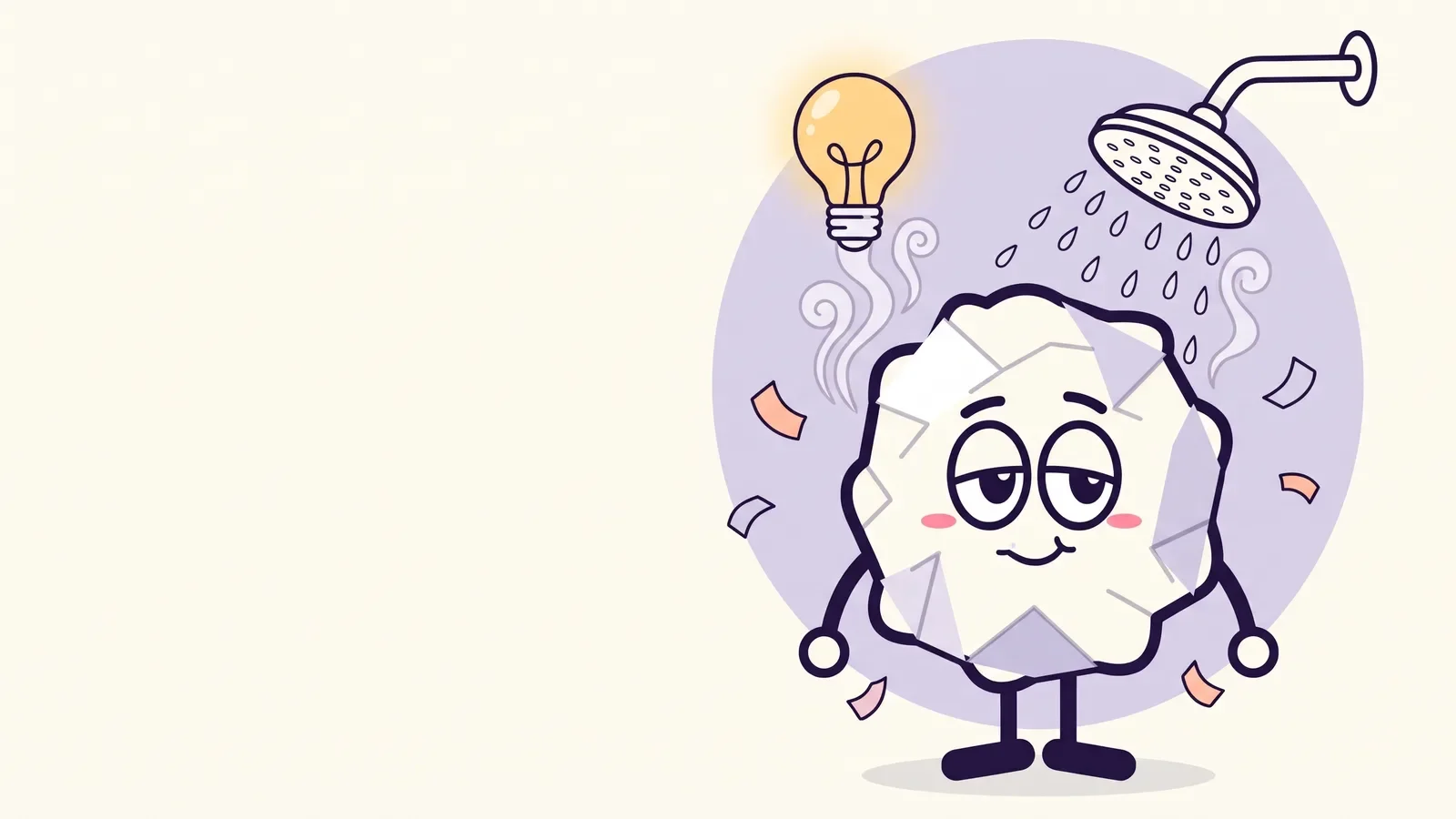
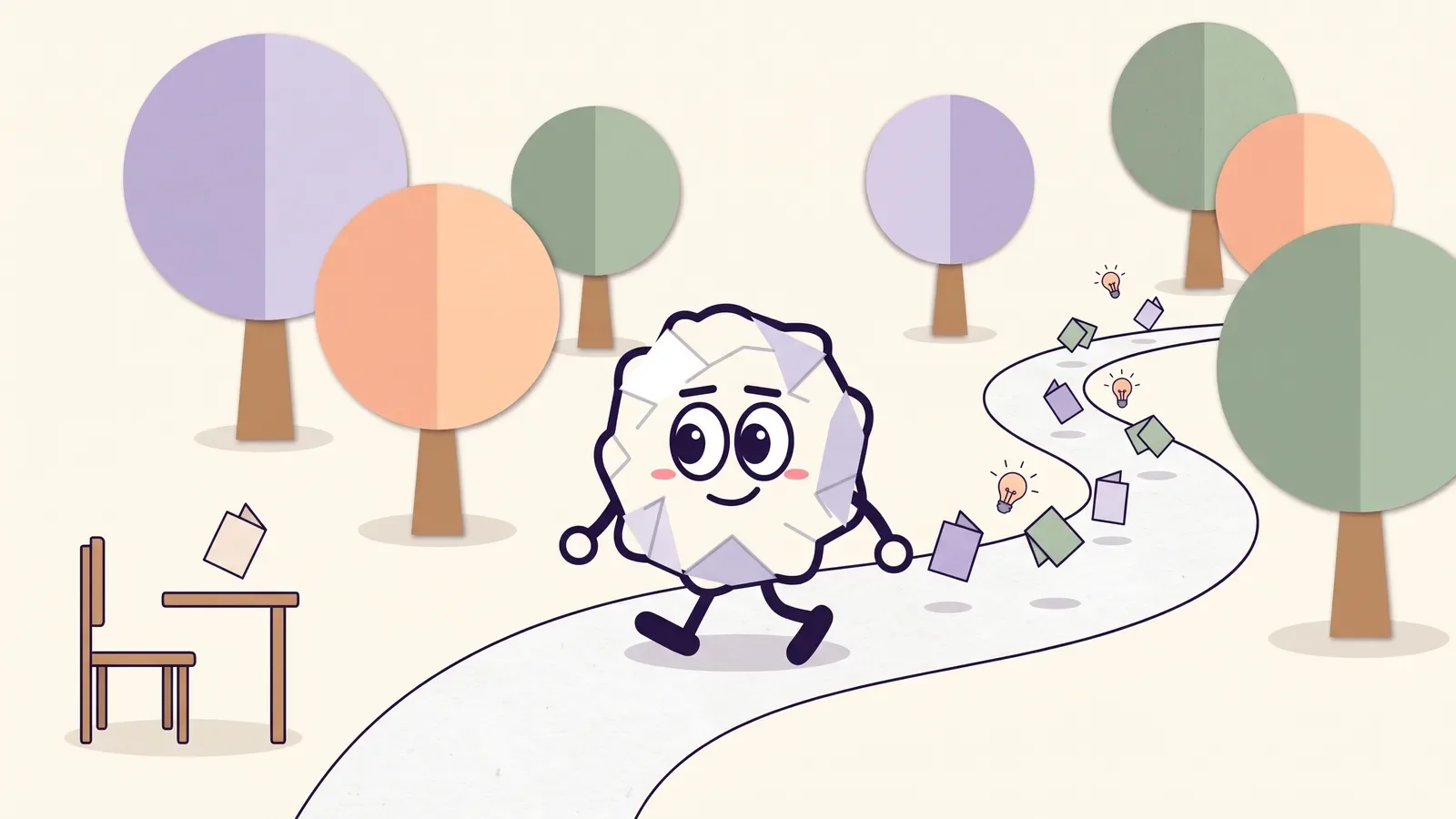
This video has no narration. Pip, the Spitball paper-ball character, stands relaxed under a simple shower head as steam curls up into a glowing lightbulb. Then three scenes show Pip frowning at a tangled knot, folding a towel as the knot loosens, and cheering as the string loops around a lit bulb. Next, Pip walks a winding park path while paper cards and small lightbulbs float up behind each step. Finally, Pip in a beanie stands by a steamy door and speaks an idea into a plain phone showing only a sound wave. Captions: Why do ideas show up in the shower? It's moderately engaging. Your mind can wander, loosely. In a 2024 study, mind-wandering helped only during an engaging task. Breaks can help on problems you've already started. Evidence is mixed. Walking boosted creative ideas for most people in Stanford studies. Try it: load the problem, leave it, then land the idea. Save it the moment you're out.
Your best ideas often show up in the shower because showering is moderately engaging: it holds a little attention while leaving your mind free to wander. In a 2024 study, mind-wandering predicted more creative ideas only during an engaging activity, not a boring one. Stepping away from a problem can help, though results are mixed.
This guide is for anyone who has solved a problem with shampoo in their hair and wondered why. It explains what the research on mind-wandering, incubation and walking actually found, where it stops, and how to set up more shower-style moments on purpose. Spitball is our app, so where we mention it we've kept to what it actually does.
Every research claim links to the original paper; we checked each DOI and the numbers we quote on October 23, 2026. Apple details come from Apple's iPhone User Guide (iOS 27), checked the same day. Spitball details come from Spitball's published support and privacy pages.
What is the "shower effect"?
The "shower effect" is the everyday experience of a good idea arriving while you're doing something routine, like showering or walking, instead of while you're working on the problem. Researchers study it under two names: incubation, which is setting a problem aside for a while before coming back to it, and mind-wandering, which is thought that drifts away from whatever you're doing.
The idea that good thoughts come when you're doing something else is old. What's newer is a specific explanation of why some activities work better than others. In their 2024 paper, Zachary Irving, Caitlin Mills and colleagues frame it as a balance. Creative idea generation, they write, "requires a balance between focused, linear thinking (which limits originality) and unbounded, random associations (which are rarely useful)." An activity like showering or walking may help strike that balance "by allowing mind wandering in an engaging environment that places some constraints on thought" (Irving et al., 2024, Psychology of Aesthetics, Creativity, and the Arts).
That framing matters because it predicts something specific. If you're fully absorbed in a hard task, your mind can't wander. If you're bored stiff, it may wander anywhere at all. The sweet spot is an activity that occupies part of your attention, lightly, while the rest is free to roam. A shower fits: you do it on autopilot, but the water, warmth and routine keep your thoughts loosely anchored. The rest of this guide looks at how well the evidence supports that idea.
What's happening in the brain? Imaging research links idea generation to the default mode network, regions that are active when attention turns inward, as in mind-wandering, working together with control networks that evaluate and refine ideas (Beaty et al., 2016, Trends in Cognitive Sciences). In a 2024 study of 13 patients with implanted electrodes, briefly stimulating default-network regions made their ideas for object uses less original, without changing how many ideas they had (Bartoli et al., 2024, Brain). No study we found has recorded anyone's brain in a shower, so treat this as background, not proof.
What did the shower-effect study actually find?
It found that mind-wandering was linked to more creative ideas, but only when people were doing something moderately engaging. During a boring activity, how much people's minds wandered made no difference to how many ideas they came up with.
Nobody was filmed in a shower. In the first experiment, 217 undergraduates at a university in the northeastern US worked in a lab. They listed alternative uses for a brick or a paperclip, a standard creativity test. Then came a three-minute break. Half watched a deliberately boring video of men folding laundry, and half watched a moderately engaging clip from the film When Harry Met Sally. Afterward, they went back to listing uses and reported how much their thoughts had moved freely from topic to topic during the video. A second experiment repeated the design.
The authors' summary: "Across two studies, we find that mind wandering leads to more creative ideas, but only during moderately engaging activities" (Irving et al., 2024). There was a twist. The boring video also led to more ideas, or more unusual ones, overall, but those gains were unrelated to mind-wandering. The authors suggest boring activities may help by "affording time for focused problem solving," while engaging ones help by "encouraging productive mind wandering."
Keep the scope in mind. The activities were videos, not showers or walks. The sample was students, the break lasted three minutes, and the creativity measure was a lab task about everyday objects. Mind-wandering was self-reported, and the result is a correlation within each condition, not proof that wandering causes ideas. It's a careful test of the shower theory, not a study of showers.
Does stepping away from a problem really help?
Often, yes, though why is less settled. A 2009 meta-analysis of incubation studies found a positive effect of setting a problem aside, especially for open-ended idea tasks and after a longer stretch of work beforehand (Sio & Ormerod, 2009, Psychological Bulletin). The popular explanation, that mind-wandering during the break does the work, comes mainly from one 2012 study, and later replications didn't confirm it. Treat a break as a likely boost, not a rule.
In 2012, Benjamin Baird, Jonathan Schooler and colleagues at the University of California, Santa Barbara tested 145 students aged 19 to 32 (Baird et al., 2012, Psychological Science). Each spent two minutes per problem listing unusual uses for everyday objects. Then they took a 12-minute break doing one of three things: a demanding memory task, an undemanding task that needed only occasional responses, or resting quietly. A fourth group got no break. Compared with the other groups, doing the undemanding task during the break "led to substantial improvements in performance on previously encountered problems." They also reported more mind-wandering, but not more deliberate thinking about the creativity task.
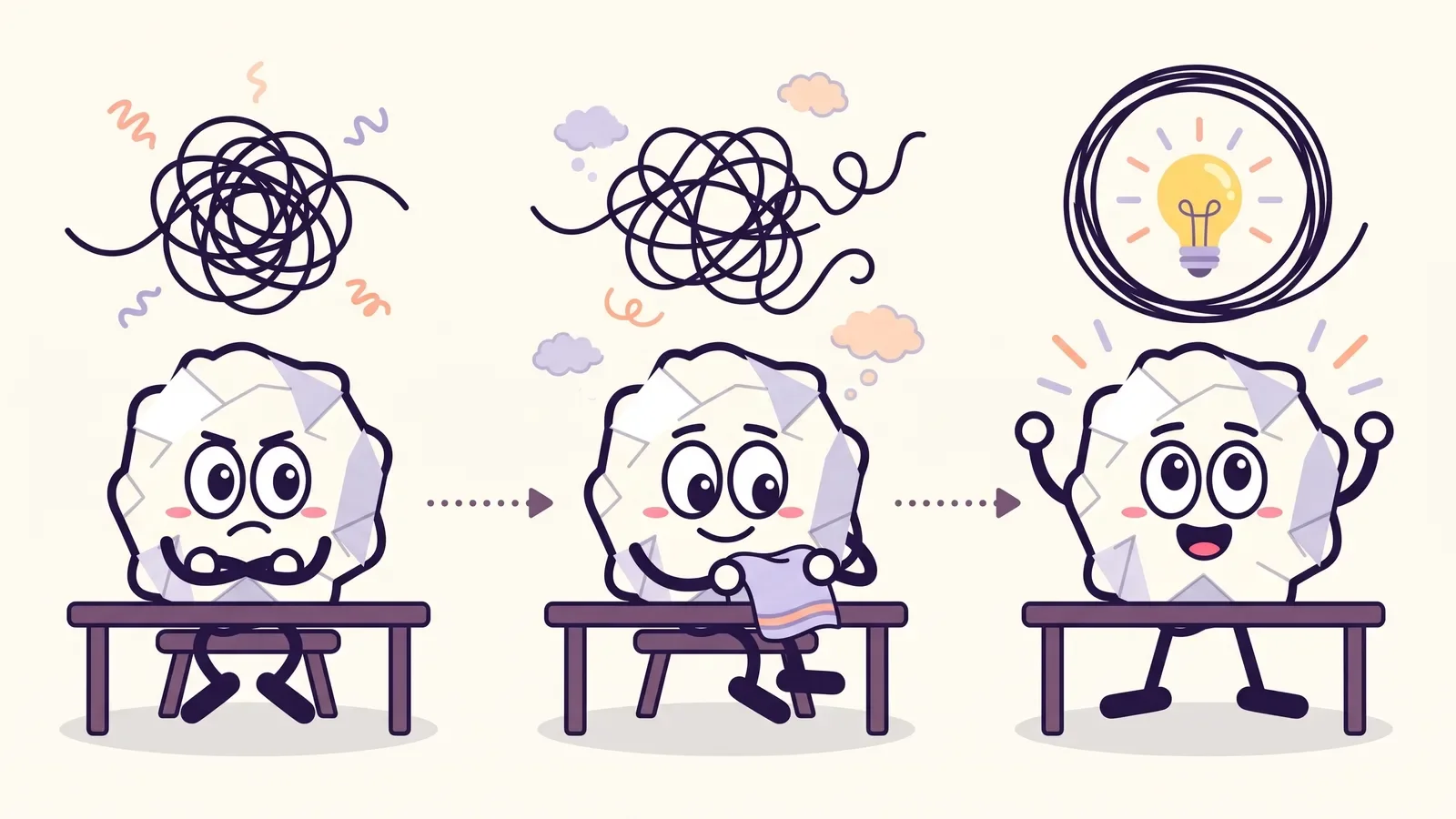
Two details are easy to miss. First, the benefit appeared only on problems people had already started, not on new ones. Incubation works on something you've loaded in. Second, the authors' conclusion was hedged: simple tasks that let the mind wander "may facilitate creative problem solving."
That hedge turned out to be wise. The part that didn't hold up was the mind-wandering link. In a conceptual replication across two studies with 443 participants, Murray, Seli and colleagues "found no evidence for the claim that mind wandering during a creative-incubation interval facilitates" divergent creativity (Murray et al., 2024, Psychology of Aesthetics, Creativity, and the Arts). Their larger point is that "task-unrelated thought" may be the wrong thing to measure. An earlier individual-differences study also found that mind-wandering during incubation didn't predict later creativity (Smeekens & Kane, 2016). Another study found that creative performance after different kinds of breaks was about the same as with no break at all (Steindorf, Hammerton & Rummel, 2021). The 2024 shower-effect paper offers one explanation for the mixed record: earlier studies often used boring tasks, which may encourage unproductive wandering. In short: breaks help on average; the mind-wandering explanation is what didn't replicate.
Why does walking seem to work like a shower?
Walking is the best-tested "shower-like" activity. In a set of four Stanford experiments, walking boosted people's ability to generate creative ideas, both while they walked and for a short time afterward.
Marily Oppezzo and Daniel Schwartz had adults list creative uses for objects while sitting and while walking on a treadmill facing a blank wall (Oppezzo & Schwartz, 2014, Journal of Experimental Psychology: Learning, Memory, and Cognition). "Walking increased 81% of participants' creativity" on the uses test in the first experiment, which had 48 participants. Across the three uses experiments, 81%, 88% and 100% of participants were more creative walking than sitting (the 100% was a group of 10 who walked an outdoor campus path). People also produced roughly 50% more total ideas, good and bad, while walking (33.1 versus 22.2 on average).
Three findings make this more than "go for a walk":
- The boost lingered. When people sat down after walking, they "exhibited a residual creative boost." You can walk first and work afterward.
- It helped generating, not solving. On a test with one correct answer (finding the word that links three others), only 23% improved while walking, and walking mildly hurt performance overall. Walking opens up ideas; it doesn't check them.
- Outside added something. In the analogy experiment, walking outside produced the most novel, highest-quality analogies, and the authors found the effects of walking and of outdoor stimulation were separable.
This fits the balance idea well. Walking is automatic enough to free your mind and engaging enough, with a changing view and a path to follow, to keep it loosely anchored. That's why so many people do their best thinking on a walk, and why a shower can feel similar.
Which everyday activities are most likely to spark ideas?
Look for activities that are automatic but not empty. Pulling the three studies together gives a simple test you can apply to your own day. It's our synthesis of the research, not a result any single study measured.
A good "idea incubator" usually passes three checks:
- Low demand. It doesn't need your working memory. In Baird's study, the demanding memory task produced less mind-wandering than the easy one. Answering email, driving in heavy traffic or a hard workout probably fail this check.
- Some engagement. It holds a bit of your attention, through movement, a changing scene or a light story. That's what separated the engaging video from the laundry video in the 2024 study. A shower, a walk, cooking a familiar meal or washing dishes plausibly fit.
- A loaded problem. You thought hard about something beforehand. Incubation benefits in Baird's study appeared only on problems people had already worked on.
One caution about examples: in the 2024 study, watching a video of people folding laundry was the boring condition. That doesn't tell us whether folding your own laundry is boring or engaging, because doing an activity is different from watching it. No study we checked compared specific household chores, so treat any list of "best activities" as a hypothesis to test on yourself.
A practical way to test it: for one week, note where your useful ideas show up. Most people find two or three reliable places. Those are worth protecting, and worth pairing with a hard problem before you go.
What doesn't the research show?
The research supports a plausible mechanism and a few useful habits. It doesn't prove that showers make you creative, and most of it comes from short lab tasks.
- No study here tested showers. The "shower effect" study used videos. Showers are the everyday example, not the experimental condition.
- The mind-wandering explanation is shaky. Breaks help on average across incubation studies, but Baird et al.'s finding that mind-wandering during the break drives the benefit didn't hold up in later replications, including one with three times the sample.
- Mind-wandering was self-reported. People rated their own wandering after the fact, which is imprecise.
- The creativity tests were narrow. Listing uses for a brick isn't the same as solving a work problem or writing a song.
- Samples were mostly students. Most participants were undergraduates tested over minutes, not professionals tested over weeks.
- Walking helps generate, not judge. It didn't help single-answer problems, so check your walking ideas at a desk later.
The most defensible version: work on a problem, step away to something light but engaging, and expect ideas to show up more often, not every time.
How can you have more shower-style ideas on purpose?
Use a three-step routine: load the problem, leave it for something moderately engaging, then land the idea by saving it right away. Each step maps to one of the findings above.
- Load (10 minutes). Work on the problem properly first. Write or say the question in one sentence, list what you've tried, and name what's blocking you. Incubation in Baird's study only helped on problems people had already started.
- Leave (10 to 30 minutes). Switch to an activity that passes the three checks: a walk, a shower, cooking something you know by heart. Leave your phone's feeds alone; you want your mind free to drift, not filled with someone else's content. If you can, walk outside.
- Land (under a minute). When an idea shows up, save it as soon as you safely can, in your own words, before the next thing crowds it out. Then check it later at a desk, since walking helps you generate ideas, not judge them.
Try it with one real problem this week, such as a stuck paragraph, a decision you keep postponing or a name for a project. Run the routine twice, on different days, and compare what came back.
If you like to talk ideas through as part of the "load" step, our guide to the benefits of thinking out loud explains when speaking helps and when it can get in the way of a sudden insight.
How do you save an idea from the shower before you forget it?
Repeat it to yourself in a few key words, then save it the moment you're out and dry. Don't take your phone into the shower. Apple's own water-resistance guidance says to avoid "pressurized water or high velocity water, such as when showering" (Apple Support). If you want something within reach, a waterproof notepad on the shower wall works without a phone. For the full capture-and-review system, see our guide on how to capture ideas before you forget them.
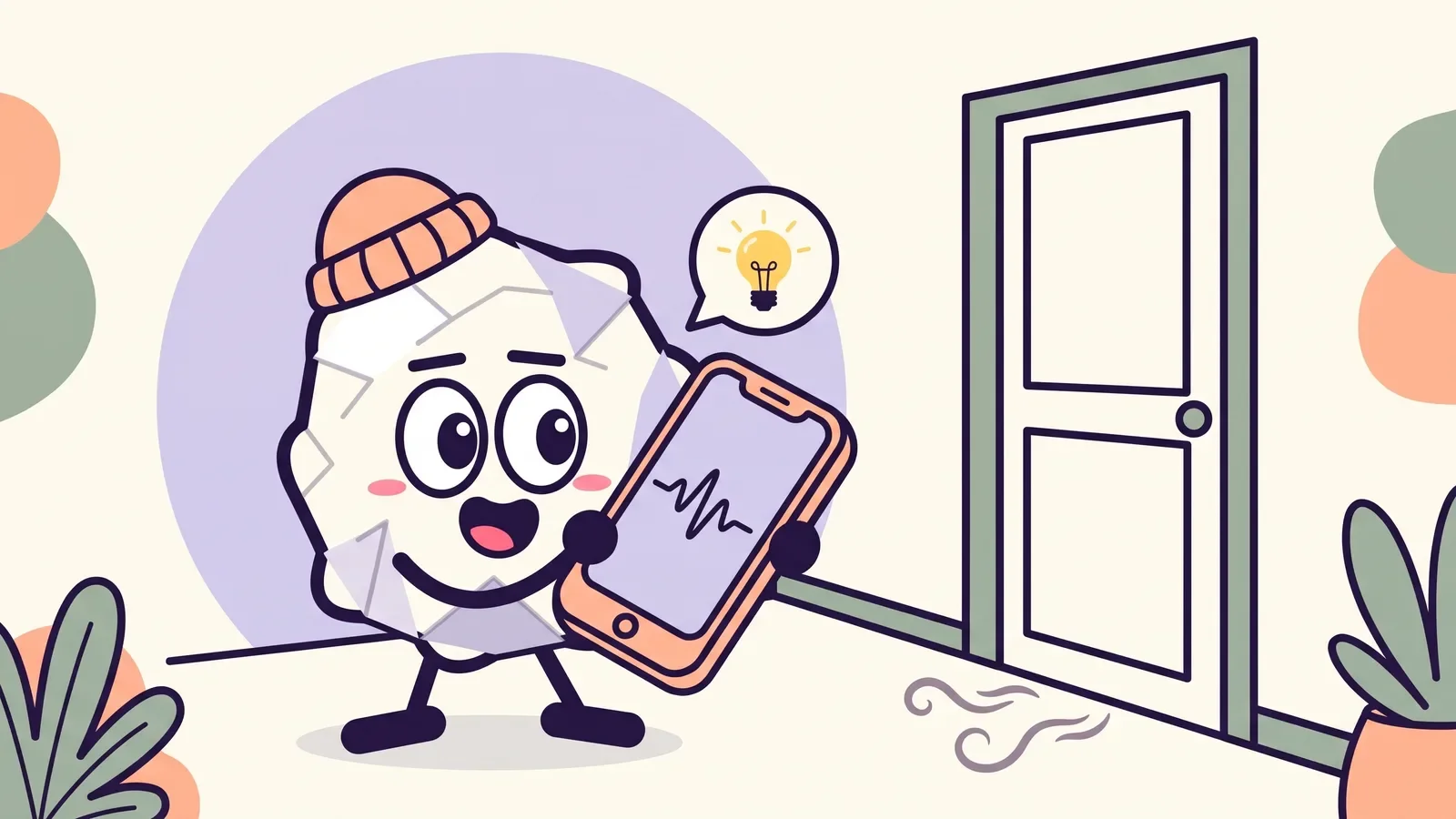
The fastest save is usually spoken: say the idea and why it matters in a sentence or two. On iPhone models with an Action button, you can assign it to Apple's Voice Memo action ("Record personal notes, musical ideas, and more") or to Spitball's capture shortcut, then press and hold to start (Apple: Use and customize the Action button). Our guide to saving a voice note with the Action button walks through both.
Spitball transcribes English on your iPhone using Apple's on-device speech capabilities, with no cloud transcription fallback, so you can later search for a word you remember. The first transcription may need a speech-model download, support varies by device, transcripts can contain errors, and the original audio is kept (how on-device transcription works on iPhone). Your library is stored on your iPhone by default, with optional iCloud Sync using your own Apple Account, and no Spitball account is required. Optional analytics start off, and TestFlight separately sends Apple's beta diagnostics; details are on the privacy page. For every other way to record, see how to take voice notes on iPhone.
Spitball is currently in beta through Apple's TestFlight. You'll need iOS 17 or later, and beta places are limited. It's free right now and iPhone only, with a Mac app coming soon. Get Spitball. Questions? Start with Spitball Support, or DM Nik, Spitball's developer, at @sharma on Instagram.
A FEW MORE ANSWERS
Good questions.
Why do I get my best ideas in the shower?
Likely because showering is moderately engaging. It runs on autopilot, which frees your mind to wander, but it holds enough attention to keep your thoughts loosely anchored. A 2024 study found mind-wandering predicted more creative ideas only during a moderately engaging activity, not a boring one. It helps most when you've already worked on the problem beforehand.
Is the shower effect real?
Partly. The experience is common, and a 2024 study supports one explanation: mind-wandering helped idea generation during a moderately engaging video. A 2009 meta-analysis found that setting a problem aside helps on average, especially for open-ended idea tasks. But no study we checked tested real showers, and a widely cited 2012 finding that mind-wandering during the break drives the benefit wasn't reproduced in later replications. Treat it as a useful tendency, not a guarantee.
What is incubation in creativity?
Incubation is the period when you set a problem aside before returning to it, hoping a better idea emerges. In lab studies, people work on a creativity task, take a break doing something else, then try again. A 2009 meta-analysis of incubation studies found a positive effect on average, larger for open-ended tasks and after longer work beforehand. Why it works is less settled: a 2012 mind-wandering explanation failed later replications.
Does walking make you more creative?
For generating ideas, the evidence is good. In Stanford experiments, most participants (81% in the largest test, with 48 people) came up with more creative uses for objects while walking than while sitting, and the boost lasted briefly after they sat down. Walking didn't help problems with a single right answer, so use walks to generate options and check them later.
Does boredom make you more creative?
Not in the way people often assume. In the 2024 shower-effect study, a boring video led to more ideas or more unusual ideas overall, but those gains weren't linked to mind-wandering. The authors suggest boredom may simply give people time for focused problem solving. Mind-wandering helped only during the moderately engaging activity.
How do I remember ideas I get in the shower?
Repeat the idea to yourself in a few key words, then save it as soon as you're out, before anything else crowds it out. Saying it aloud into a voice note is usually fastest. On iPhones with an Action button, you can set it to start a Voice Memo, or to Spitball's capture shortcut, with a press and hold.
What happens in your brain when you get an idea in the shower?
Brain-imaging research links idea generation to the default mode network, a set of regions active when attention turns inward, such as during mind-wandering, working with networks that evaluate and refine ideas. In a 2024 study of 13 patients with implanted electrodes, briefly stimulating default-network regions made their ideas less original. No study we found has scanned anyone in a shower, so this is background, not proof.
Can I take my phone in the shower to record ideas?
Probably better not to. Apple's water-resistance guidance for iPhone says to avoid exposing it to pressurized or high-velocity water, "such as when showering," and to avoid steam rooms and soap. Water resistance can also decrease with normal wear, and liquid damage isn't covered by Apple's warranty. Keep your phone outside the splash zone, hold the idea in a few key words, and record it once you're out. A waterproof notepad on the wall is a no-phone option.
WRITTEN BY
Nik Sharma
Nik is an entrepreneur, active investor, and the founder of Spitball. He writes about building businesses, practical AI, and catching ideas before they disappear.