 spitball

THE SHORT VERSION
What to take away
- Saying a word or line aloud makes it more memorable than reading it silently, an effect psychologists call the production effect.
- The production effect is strongest by contrast: say the one line that matters most, not everything, so it stands out.
- Explaining an idea to yourself improves understanding; a meta-analysis of 64 reports found an average effect of g = .55.
- Plain narration of your thoughts barely changes performance, and in some studies verbalizing got in the way of sudden insights.
- Try a 60-second voice note: say the headline, explain why it works, name a next step, then repeat the headline.
WATCH THE IDEA
Thinking out loud, in under 30 seconds
A short illustrated clip on what research says about thinking out loud: saying your key line aloud makes it stand out in memory (the production effect), narrating barely changes performance, explaining why an idea works deepens understanding, and a 60-second voice note (headline, explain, next step, repeat) puts it into practice.
Read the video transcript
This video has no narration. Pip, the Spitball paper-ball character, talks with one hand raised as paper ribbons flow from its mouth and wrap around a lightbulb that slowly glows. Then Pip speaks toward one white card on a clothesline of grey cards, and sound waves make that card glow brighter than the rest. Next, on the left Pip walks a straight dotted line trailing a plain ribbon, while on the right Pip fits two puzzle pieces together with a sparkle. Finally, Pip stands beside a plain phone outline with a soft sound wave while a stopwatch hand sweeps forward next to three folded cards showing a lightbulb, a question mark and an arrow. Captions: Thinking out loud helps in two ways. Saying a line aloud makes it stand out in memory. It's called the production effect. Say the line that matters most. Narrating your thoughts barely changes performance. Explaining why an idea works deepens understanding. Try 60 seconds: headline, explain, next step, repeat. Then replay it later in your own voice.
Thinking out loud helps in two well-studied ways: saying something aloud makes it more memorable than reading it silently, and explaining an idea to yourself, rather than just narrating it, deepens understanding. The catch is that plain narration barely changes performance, and in some studies talking got in the way of a sudden insight.
This guide is for anyone who talks ideas through on walks, in the car or into a voice note and wonders whether it's actually doing anything. It covers what the research shows, where it stops, and a 60-second way to use it. Spitball is our app, so where we mention it we've kept to what it actually does.
Every research claim links to the original paper (checked October 22, 2026). Apple details come from Apple's iPhone User Guide (iOS 27), checked the same day. Spitball details come from Spitball's published support and privacy pages. This article is general information about thinking and memory, not medical or mental-health advice.
What does "thinking out loud" actually mean?
Thinking out loud means putting your thoughts into spoken words as you have them, whether you're alone, talking to a friend or recording a voice note. Researchers don't treat it as one thing. They study at least three different behaviors, and the differences matter more than the label.
- Saying something aloud. Reading or speaking a specific word, line or fact out loud instead of silently. Its memory benefit is called the production effect: the finding that producing a word aloud during study, compared with reading it silently, improves memory for it.
- Narrating. Describing what you're thinking as it happens ("OK, now I'm looking at the second option"). Psychologists call this think-aloud and use it to study how people solve problems.
- Explaining. Telling yourself why something is true, how the parts connect, or what follows from it. In learning research this is self-explanation.
There's a fourth, related idea, self-talk: the words you use to address yourself, silently or aloud, especially under pressure. Each of these has its own evidence, and they don't all point the same way. Saying a line aloud helps you remember that line. Explaining helps you understand. Narrating mostly just slows you down. The sections below take them one at a time, then turn the useful parts into a simple voice-note habit.
Does saying something out loud help you remember it?
Yes. Saying a word aloud makes it more memorable than reading it silently, at least in memory experiments. The effect is reliable enough to have a name, and it works by making the spoken item stand out from everything else you took in.
In eight recognition-memory experiments, Colin MacLeod and colleagues at the University of Waterloo showed that "producing a word aloud during study, relative to simply reading a word silently, improves explicit memory" (MacLeod et al., 2010, Journal of Experimental Psychology: Learning, Memory, and Cognition). Several details from that paper are useful outside the lab:
- It works by contrast. In their first three experiments, the effect showed up only in mixed lists, where people said some words aloud and read others silently. Speaking makes an item distinctive, and distinctiveness needs something to stand out from.
- Repeating the same response doesn't do it. When people made the same repeated manual or vocal response to some words, the effect disappeared. What counts is producing the item itself.
- Even mouthing helps. Articulating words without making a sound still produced the effect, as did saying pronounceable nonsense words.
The authors call the production effect "a simple but quite powerful mechanism for improving memory for selected information." Note the word selected. The practical lesson isn't to say everything aloud. It's to say the one line that matters most, deliberately, so it stands out from the rest of what you thought, read or heard that day.
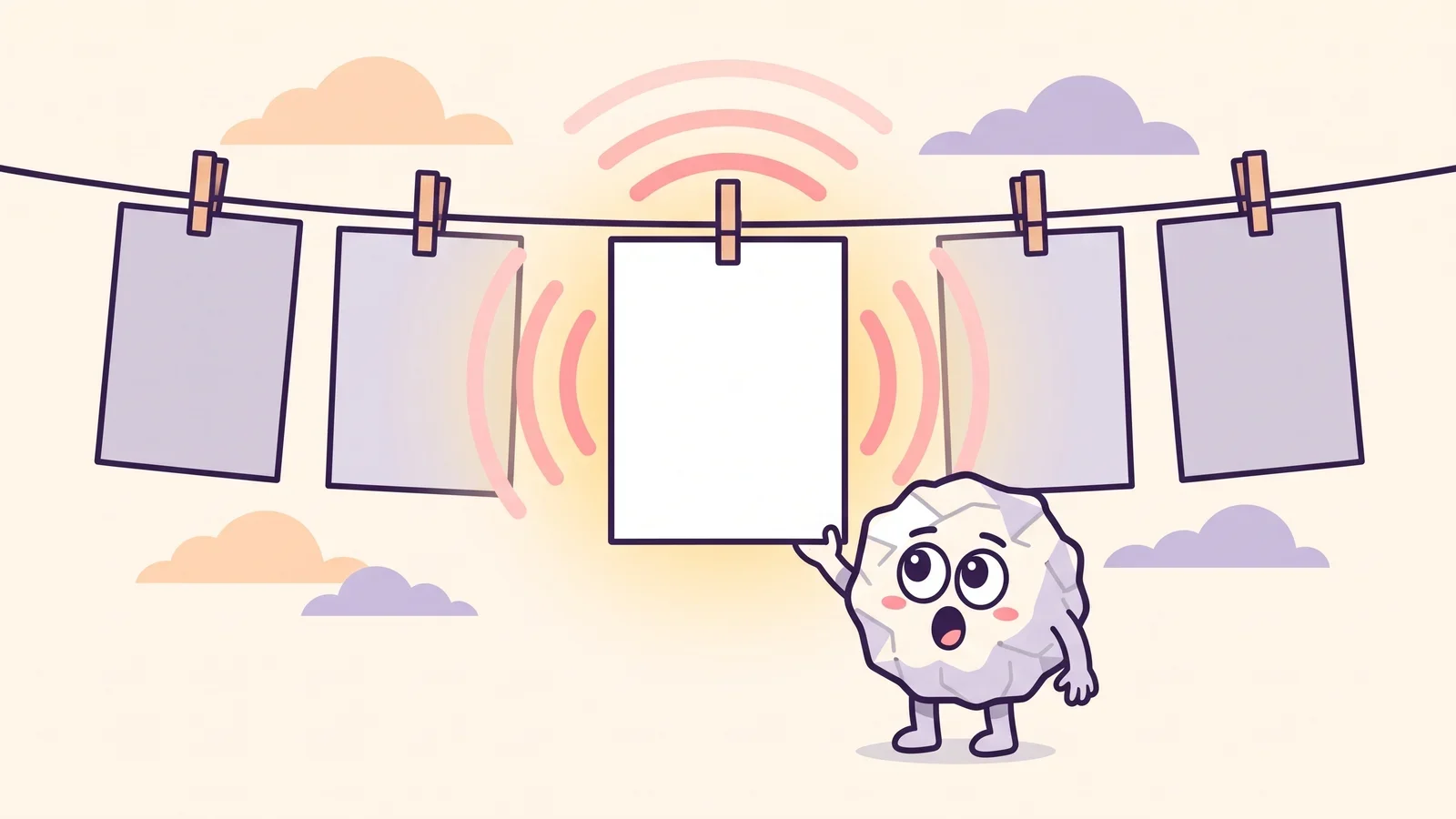
Keep the scope in mind. Most of this research uses word lists in a lab, though the benefit has also appeared after a one-week delay and for sentences and short essays (Ozubko, Hourihan & MacLeod, 2012, Memory). It helps memory more than understanding: reading passages aloud improved answers to memory questions but not to comprehension questions (Roberts et al., 2024, Memory & Cognition). For understanding, you need the next finding: explaining.
Does hearing your own recording help, too?
Hearing yourself helps more than hearing someone else, but less than speaking. That comes from the first production-effect study to include a condition where people listened to recordings of their own voice.
Noah Forrin and Colin MacLeod compared four ways of studying words: reading them aloud, hearing a recording of yourself reading them (made earlier), hearing another person read them, and reading silently (Forrin & MacLeod, 2018, Memory). They found "a gradient of memory across these four conditions, with hearing oneself lying between speaking and hearing someone else speak." Their explanation is that speaking aloud gives memory two distinctive signals: "a motor (speech) act and a unique, self-referential auditory input." In plain terms, you remember the act of saying it, and you recognize the voice as yours.
No study we found tested voice-note apps, so treat what follows as a reasonable inference rather than a proven result. If speaking a line marks it as distinctive, and hearing your own voice carries some of that benefit, then replaying your own voice note is a sensible way to review an idea. You get the original words and your own tone, which a typed summary can't give you.
It's also why the order of a voice note matters. If the key line is the first thing you say, it's the first thing you hear when you replay it. That replay usually happens in a weekly review of your captured ideas.
Does explaining an idea out loud help you understand it?
Yes, and the evidence here is broad. Explaining something to yourself, asking why and how it works, reliably improves understanding compared with just reading or studying it.
The classic study is small and vivid. Michelene Chi and colleagues asked 14 eighth-grade students to self-explain after reading each line of a passage about the human circulatory system, while 10 students in a control group read the same text twice without that prompt (Chi et al., 1994, Cognitive Science). "The prompted group had a greater gain from the pretest to the posttest." Among the prompted students, those who produced many explanations understood the most (a comparison within the prompted group, not a separate experiment): "High explainers all achieved the correct mental model of the circulatory system, whereas many of the unprompted students as well as the low explainers did not."
The finding has held up at scale. A 2018 meta-analysis pooled 69 effect sizes from 64 research reports in which learners were prompted to self-explain while studying or solving problems (Bisra et al., 2018, Educational Psychology Review). The overall weighted mean effect size was g = .55, and the authors concluded that "self-explanation prompts are a potentially powerful intervention across a range of instructional conditions."
Two caveats. These studies are mostly about learning material (texts, worked examples, problems), not about developing your own ideas, and the prompts weren't always spoken; some studies used typed explanations. What carries over is the move itself: asking yourself why and how, then answering in full sentences. For many people, speaking is the quickest way to do that.
Programmers have a name for this: rubber duck debugging. The term comes from The Pragmatic Programmer (Andrew Hunt and David Thomas, 1999), which describes explaining your code, line by line, to a rubber duck until the bug becomes obvious. No controlled study has tested the duck itself. The closest evidence is the self-explanation research above: the benefit comes from putting the why into words, whether or not anyone is listening.
Is narrating your thoughts the same as explaining them?
No, and this is the most useful distinction in the research. Narrating what you're thinking leaves performance almost unchanged, while explaining your thinking tends to improve it. Both take extra time.
Mark Fox, K. Anders Ericsson and Ryan Best ran a meta-analysis of 94 studies that compared people verbalizing while they worked with matched people working in silence (Fox, Ericsson & Best, 2011, Psychological Bulletin). Across nearly 3,500 participants, the "think-aloud" effect size was "indistinguishable from zero (r = -.03)." In contrast, "procedures that entail describing or explaining thoughts and actions are significantly reactive, leading to higher performance than silent control conditions." And: "All verbal reporting procedures tend to increase times to complete tasks."

That gives a simple rule for out-loud thinking:
- Narrating ("first I'll do this, then that") is a fine way to keep your place, but don't expect it to make you smarter about the problem.
- Explaining ("this works because…", "the risk is…", "so the next step is…") is where the benefit is. If your voice note has no "because" in it, it's probably narration.
- Budget the time. Talking it through is slower than thinking silently. Use it when understanding matters more than speed.
One newer study is a useful exception. When 103 young adults were told to talk to themselves as much as possible during a visual-spatial working memory task, they did better than when told to stay quiet (Guo & Dobkins, 2023, Consciousness and Cognition). That's one task in one lab, so it doesn't overturn the meta-analysis. But it shows that, for some tasks, talking to yourself can help.
Can thinking out loud ever get in the way?
Sometimes. In some studies, putting thoughts into words interfered with the kind of sudden insight that comes from seeing a problem differently, and saying the wrong label can slow you down.
Jonathan Schooler, Stellan Ohlsson and Kevin Brooks found that people who were interrupted to describe their problem-solving strategies were "significantly less successful" at solving insight problems than people who did an unrelated activity (Schooler, Ohlsson & Brooks, 1993, Journal of Experimental Psychology: General). In a later experiment, concurrent, nondirective verbalization "impaired the solving of insight problems but had no effect on noninsight problems." Their explanation is that verbalizing can disrupt processes that aren't easy to put into words. Later studies are mixed: in one, thinking aloud didn't hurt solving a classic insight puzzle, Duncker's candle problem (Fleck & Weisberg, 2004, Memory & Cognition), and another found that verbalizing hurt spatial puzzles more than verbal ones, with no extra cost for insight puzzles (Gilhooly, Fioratou & Henretty, 2010, British Journal of Psychology). Treat it as a possible cost, not a rule.
Words can also steer what you notice. When Gary Lupyan and Daniel Swingley asked people to say a target object's name aloud while searching for it, "speaking facilitated search, particularly when there was a strong association between the name and the visual target." But "as the discrepancy between the name and the target increased, speaking began to impair performance" (Lupyan & Swingley, 2012, Quarterly Journal of Experimental Psychology).
In practice: talk through problems that have steps, trade-offs or parts to connect. When you're stuck waiting for a creative leap, stop talking, take a walk, and record the idea when it arrives. Then explain it while it's fresh.
Does self-talk help under pressure?
Some research suggests that how you address yourself matters: talking to yourself by name, like a coach would, can make stressful moments easier to handle than talking to yourself as "I."
Across seven studies with 585 participants in total, Ethan Kross and colleagues found that using non-first-person pronouns and one's own name during introspection, instead of "I," "enhances self-distancing" (Kross et al., 2014, Journal of Personality and Social Psychology). In tasks about making a good first impression and giving a public speech, people in the non-first-person group performed better according to objective raters and "displayed less distress." They also appraised future stressors "in more challenging and less threatening terms." A meta-analysis inside the paper found the results weren't moderated by trait social anxiety. Self-talk also has a performance record in sport: a meta-analysis of 32 studies (62 effect sizes) found a moderate benefit of self-talk interventions (ES = .48), larger for fine motor and novel tasks (Hatzigeorgiadis et al., 2011, Perspectives on Psychological Science).
Two cautions. These were lab tasks about everyday social stress, and the self-talk was introspection, not necessarily spoken aloud. It isn't a treatment for anxiety or anything else. If stress, anxiety or low mood is affecting your daily life, talk to a doctor or a licensed mental-health professional. As a small habit, though, it's easy to try: in a voice note about a hard decision, ask the question with your own name ("Sam, what would you tell a friend here?").
What doesn't the research show?
The research supports a few specific mechanisms. It doesn't show that talking to yourself is a general brain upgrade, and most of it comes from controlled lab tasks.
- It isn't about voice-note apps. No study cited here tested an app, a voice note or long-term idea development. Applying the findings to voice notes is our inference.
- The memory effect is about selected items. The production effect is largest when some items are spoken and others aren't. When people say everything aloud, a meta-analysis found a smaller benefit for recognizing the material and none for overall recall (Fawcett et al., 2023, Canadian Journal of Experimental Psychology). So pick the line that matters.
- Narration isn't explanation. The large meta-analysis found plain think-aloud left performance unchanged; the gains came from describing or explaining.
- Talking isn't always better. It takes more time, and in some studies it disrupted insight problems.
- Lab samples are narrow. Many participants were students working on word lists, texts or puzzles, measured over short periods.
- It isn't therapy. Findings about self-talk and stress come from lab tasks, not clinical treatment.
None of that makes the findings weak. It makes them specific. The most defensible version is: say your key line deliberately, explain why it matters in full sentences, and review it later in your own voice.
How do you think out loud in a voice note?
Use a three-part structure: say the headline, explain it, and name the next step, then say the headline again. That turns the two strongest findings, a distinctive spoken line and self-explanation, into something you can do in under a minute.
- Headline. Say the idea in one deliberate sentence: "Idea: a book-swap shelf for our building's lobby." This is the line you want to stand out, so say it slowly, once, on purpose.
- Explain. Answer one or two of these out loud: Why would this work? What problem does it solve? What's the catch? Use "because" at least once. If there's no "because", you're narrating, not explaining.
- Next step. Say one specific action: "Next: ask the building manager if a shelf is allowed."
- Repeat the headline. End on the key line, so the note starts and finishes on what matters, and the first thing you hear on replay is the idea itself.
What makes this different from an ordinary capture is the middle step and the repeat. A quick capture only needs the idea, why it matters and a next step; our guide on how to capture ideas before you forget them covers that, plus what to say so you can find the note later. To start recording in one press, see recording a voice memo with the Action button. If you're thinking out loud with someone else, ask before you record them.
Try it: a 60-second think-out-loud exercise
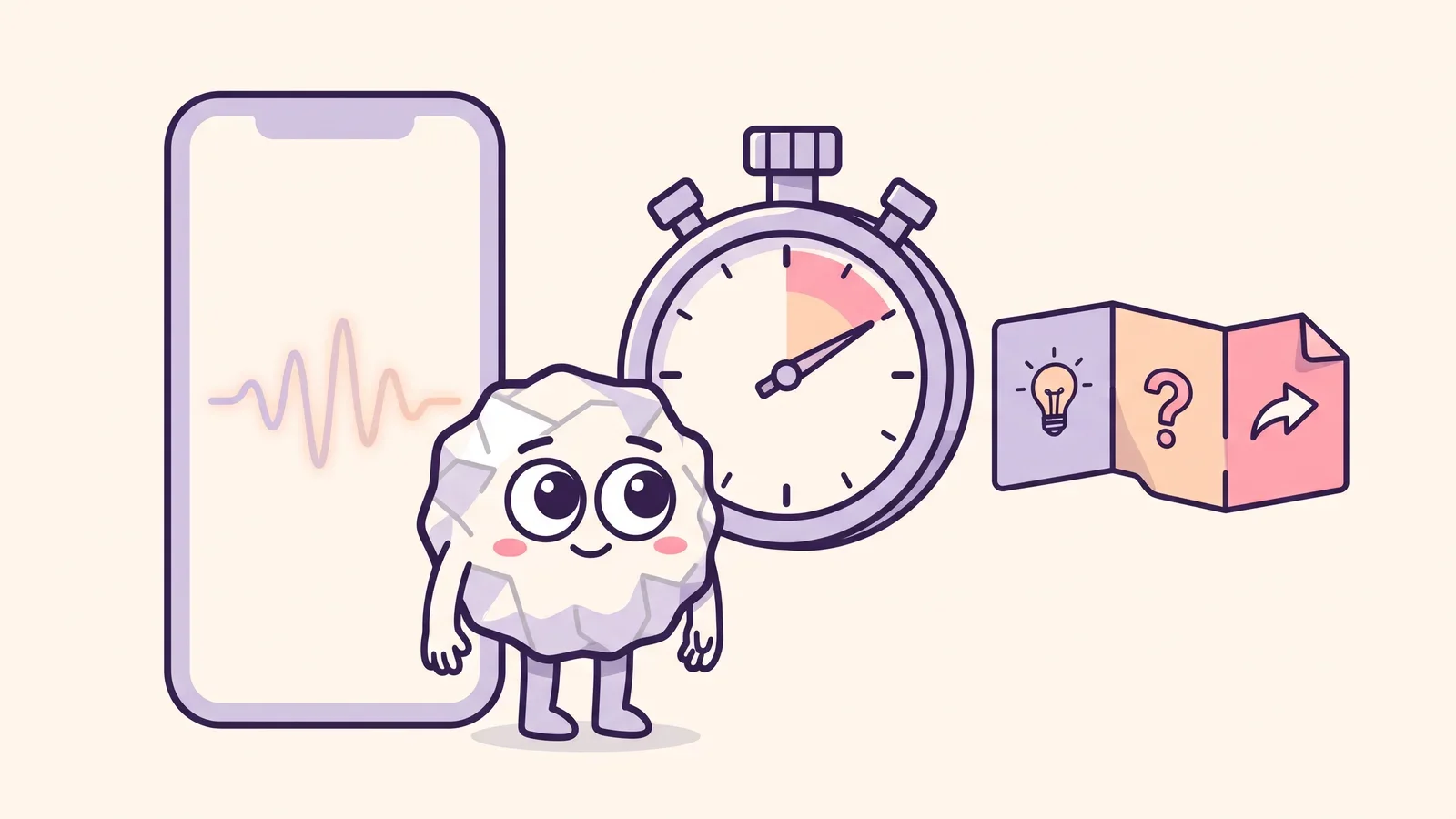
Pick one idea you've been carrying around today and give it 60 seconds out loud. You need a timer and somewhere to record, and nothing else.
- 0 to 10 seconds: headline. Say the idea in one sentence, slowly and clearly.
- 10 to 40 seconds: explain. Ask yourself "Why would this work?" and answer in full sentences. If you get stuck, try "The problem it solves is…" or "The catch is…".
- 40 to 55 seconds: next step. Name one action you could take this week, small enough to do in 15 minutes.
- 55 to 60 seconds: repeat. Say the headline again.
- Later: replay it. Listen back in a day or two. Hearing your own voice is a fair test of whether the idea still holds up.
If the explanation part felt hard, that's useful information: you've found the part of the idea you don't understand yet. That's where to think next.
Where should you record your out-loud thinking?
Use whatever you'll actually open in two seconds and review later. On iPhone that's usually Apple's Voice Memos app or a capture app like Spitball.
- Voice Memos is built into iPhone. Apple describes it as a way to record "personal notes, classroom lectures, musical ideas, and more" (Apple: Make a recording in Voice Memos). On models with an Action button, Apple lists a Voice Memo action to "Record personal notes, musical ideas, and more" (Apple: Use and customize the Action button).
- Spitball lets you record or type a thought, keeps the transcript and the original audio, and lets you add a photo or a place. Your library is stored on your iPhone by default, with optional iCloud Sync using your own Apple Account, and no Spitball account is required. Transcription runs on your iPhone with no cloud transcription fallback; see how on-device transcription works on iPhone for what that means and its limits. Optional analytics start off; if you turn them on, they send limited usage events, and TestFlight separately sends Apple's beta diagnostics. The details are on the privacy page. You can capture in the app or set the Action button to Spitball's capture shortcut: press and hold to start recording, then press and hold again to finish and save.
For every way to record on iPhone, see how to take voice notes on iPhone. If privacy is the deciding factor, our checklist on what makes a notes app private explains what to look for.
Spitball is currently in beta through Apple's TestFlight. You'll need iOS 17 or later, and beta places are limited. It's free right now and iPhone only, with a Mac app coming soon. Get Spitball. Questions? Start with Spitball Support, or DM Nik, Spitball's developer, at @sharma on Instagram.
A FEW MORE ANSWERS
Good questions.
Is it good to think out loud?
Often, yes, for specific reasons. Research shows that saying a line aloud makes it more memorable than reading it silently, and that explaining an idea to yourself improves understanding. But plain narration of what you're doing barely changes performance, talking takes more time, and in some studies verbalizing got in the way of insight problems. Think out loud when you need to understand or remember something, not for every thought.
Does saying things out loud help you remember them?
In memory experiments, yes. MacLeod and colleagues found across eight experiments that producing a word aloud improved memory compared with reading it silently, even when the words were only mouthed. The benefit was clearest when some items were spoken and others weren't, because speaking makes the spoken item distinctive. So say your most important line aloud on purpose.
What is the production effect?
The production effect is the memory advantage for information you say aloud compared with information you read silently. Researchers think it works because producing an item adds distinctive information, such as the act of speaking and hearing your own voice, that helps you tell it apart from other things later. It has been shown mostly with word lists in lab settings, and also for sentences and short texts after a week's delay.
Is thinking out loud the same as talking to yourself?
They overlap but aren't identical. Thinking out loud usually means speaking your reasoning as you work, by narrating or explaining. Self-talk is how you address yourself, silently or aloud. Kross and colleagues found that addressing yourself by name, rather than as "I," helped people handle lab tasks involving social stress. Those were lab studies of everyday stress, not a treatment for anxiety.
Does recording yourself help you think?
There is no direct study of voice-note apps, so treat this as a reasonable inference. Explaining an idea in full sentences improves understanding, and one study found that hearing a recording of your own voice helped memory more than hearing someone else, though less than speaking. A short voice note you replay later combines both.
How long should I talk through an idea?
Often a minute is enough to get the headline, a short explanation and a next step. Research shows verbalizing tends to increase the time tasks take, so keep it short when speed matters. One idea per recording is easier to review. In Spitball, each recording can be up to 5 minutes long.
Is thinking out loud a sign of intelligence?
We found no research showing that thinking out loud is a marker of intelligence. The research points to something narrower: speaking can help with particular tasks. Saying an object's name aloud sped up visual search when the name matched the object well, and in a study of 103 young adults, talking to themselves improved performance on a visual-spatial memory task compared with staying silent. It's a tool that helps some tasks, not a measure of how smart you are.

WRITTEN BY
Nik Sharma
Nik is an entrepreneur, active investor, and the founder of Spitball. He writes about building businesses, practical AI, and catching ideas before they disappear.