 spitball

THE SHORT VERSION
What to take away
- To remember what you read, close the book after each chapter and recall the main ideas from memory before checking.
- In a 2006 study, students who read a passage once and recalled it three times remembered 61% of its ideas a week later, versus 40% for rereading only.
- Closed-book recall beat concept mapping with the text open, including on questions that required connecting ideas.
- Spaced reviews work better than back-to-back ones; recall each chapter again a few days and a week or two later.
- Saying your recap aloud may push you to finish each idea: for key-term definitions, produced recall beat silent recall, though word-pair studies found no difference.
WATCH THE IDEA
Close the book, then say it back
A short illustrated clip on remembering what you read: close the book after each chapter, recall the main ideas from memory instead of rereading or highlighting, space your reviews over days and weeks, and save one spoken recap per chapter.
Read the video transcript
This video has no narration. Pip, the Spitball paper-ball character, sits with a lavender book and talks happily as small paper cards float up toward a glowing lightbulb. Then two panels show Pip drowsily highlighting an open book as notes drift away, and Pip with the book closed waving beside a growing stack of cards. Next, Pip walks a winding path past three books on stones as each lightbulb glows brighter and the sun gives way to the moon. Finally, Pip sits in an armchair by a reading lamp and speaks a recap into a plain phone. Captions: Finished a chapter? Close the book. Say the main ideas from memory, in your own words. Recalling beat rereading a week later in a 2006 study. Rereading feels familiar. Recall shows what you know. Recall again a few days later, then a week or two later. One spoken recap per chapter. Then check what you missed.
To remember what you read, close the book at the end of each chapter and recall the main ideas from memory, out loud or on paper, before checking what you missed. Then recall it again a few days later. Retrieval practice and spaced review have the strongest evidence; rereading and highlighting are much weaker.
This guide is for anyone who finishes a good nonfiction book and, a month later, can barely say what it argued. It covers what the research on remembering text actually found, where it stops, and a 60-second spoken recap you can run after every chapter. Spitball is our app, so where we mention it we've kept to what it actually does.
Every research claim links to the original paper; we checked each DOI and the numbers we quote on October 24, 2026. Apple details come from Apple's iPhone User Guide (iOS 27), checked the same day. Spitball details come from Spitball's published support and privacy pages.
Why do you forget what you read so quickly?
Mostly because reading feels like learning even when little is being stored. While the page is in front of you, every idea makes sense, so you assume you'll keep it. Without any effort to pull those ideas back out of memory, a lot of it fades: in the study below, students who only reread a passage recalled 83% of its ideas when tested five minutes later, but a separate group who studied the same way recalled only 40% a week later.
A well-known 2006 experiment captured both halves of that problem (Roediger & Karpicke, 2006, Psychological Science). In its second experiment, 180 undergraduates at Washington University in St. Louis learned one of two short prose passages (256 and 275 words), taken from TOEFL reading-comprehension materials. One group read it in four study periods. Another read it three times and then wrote down everything they could remember. A third read it once and then recalled it three times. Nobody got feedback on their recall.
Then the researchers asked students how well they expected to remember the passage a week later. The group that only reread it was the most confident. That group had read the passage about 14 times on average, compared with about 3 times for the group that recalled it most. The confidence came from familiarity, and familiarity is exactly what rereading builds. As the next section shows, it didn't hold up a week later.
The practical lesson: the feeling of "I know this" while the book is open tells you little about what you'll remember once it's closed.
What is the best way to remember what you read?
Practice pulling the ideas out of your head instead of putting them in again. Researchers call this retrieval practice, and it's one of the most consistently supported learning techniques in psychology.
In the 2006 experiment above, each student took one final test, either five minutes or one week after studying, and the results flipped depending on when. Five minutes after studying, the rereading group recalled the most: 83% of the passage's ideas, versus 78% for the group that recalled once and 71% for the group that recalled three times. One week later, the order reversed: 61% for the group that recalled three times, 56% for one recall, and 40% for the group that only reread. Recalling beat rereading over the long run, even though those students read the passage far fewer times (about 3 versus 14) (Roediger & Karpicke, 2006).
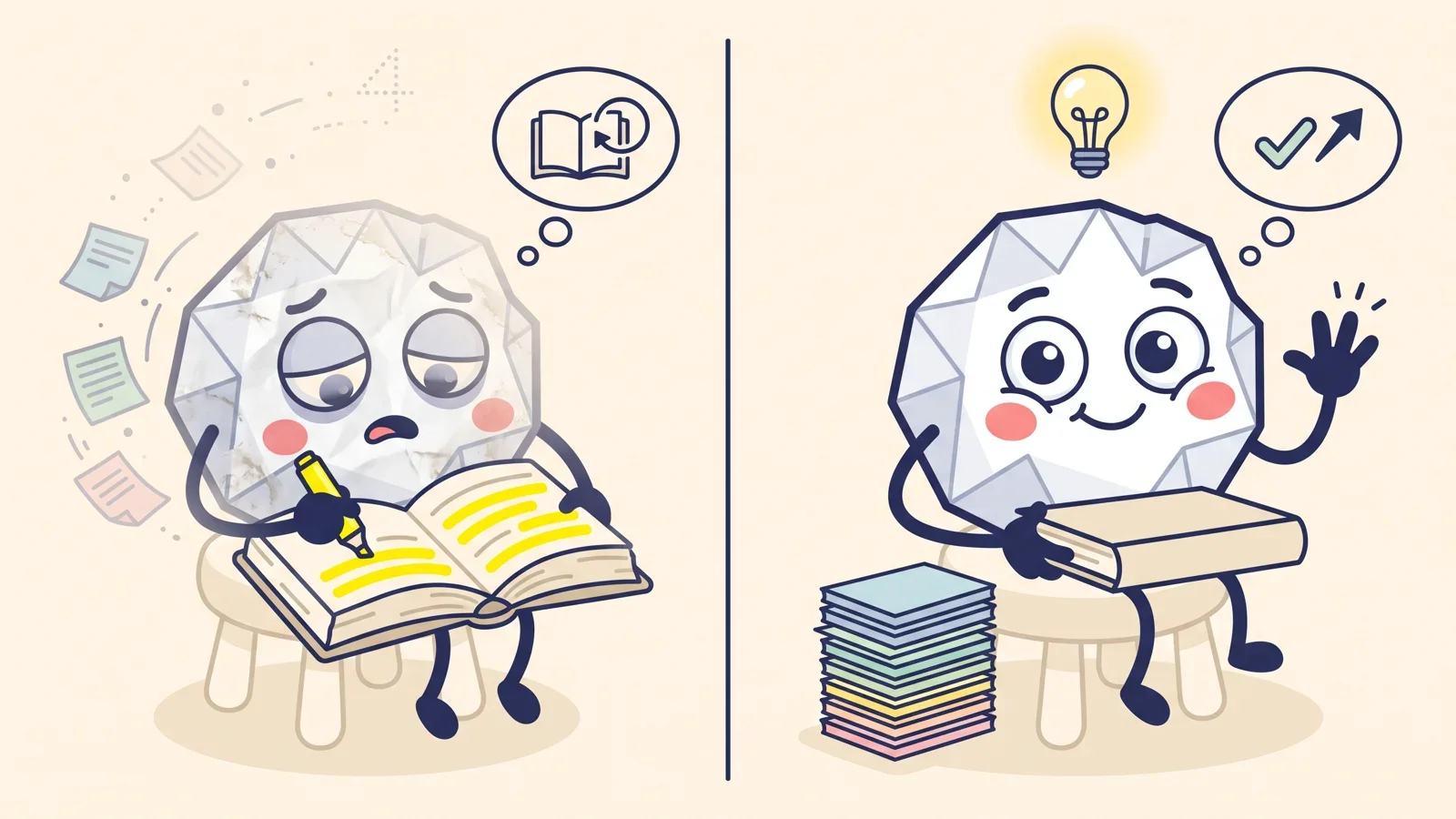
The finding isn't a one-off. A 2013 review of ten popular study techniques rated practice testing and spaced practice as the only two with "high utility," and rated rereading, highlighting and summarization as low (Dunlosky et al., 2013, Psychological Science in the Public Interest). Meta-analyses of the testing-effect literature reach the same broad conclusion that testing yourself beats restudying (Rowland, 2014, Psychological Bulletin; Adesope, Trevisan & Sundararajan, 2017, Review of Educational Research).
Rowland's meta-analysis put the average advantage of testing over restudying at g = 0.50, and two of its details matter for readers. The benefit was larger when the final test came a day or more later (g = 0.69, versus 0.41 under a day) and when people got feedback on their answers (0.73, versus 0.39 without). Producing answers from cues beat recognizing them from options, though open-ended free recall, the closest match to a chapter recap, did better than recognition only in studies where people got feedback or recalled most of the material on their first try. Recognizing a highlighted sentence still isn't the same as explaining it with the book shut.
Is taking notes or making a mind map better than recalling?
Not in the best-known direct comparison. Notes and maps made with the text open help you organize ideas, but closed-book recall did more for long-term memory and understanding.
In a 2011 study in Science, Jeffrey Karpicke and Janell Blunt at Purdue compared retrieval practice with concept mapping, a popular way to diagram how ideas connect (Karpicke & Blunt, 2011). In the first experiment, 80 undergraduates studied a science text. The concept-mapping group drew maps while viewing the text. The retrieval group read the text, wrote down everything they could recall, reread it and recalled again. Total learning time was matched.
A week later, on a short-answer test, the retrieval group scored 67% against 45% for concept mapping, which the authors describe as about a 50% improvement. The advantage held for inference questions, which required connecting several ideas, not only for facts stated in the text. In a second experiment with 120 students, retrieval practice still won when the final test asked students to draw a concept map from memory, and 101 of the 120 did better after retrieval. Most students expected concept mapping to work at least as well.
Concept-mapping researchers objected that the students got only brief instruction in mapping, with no real guidance or feedback and no check that they had mastered it (Mintzes et al., 2011, Science). A 2021 follow-up from the same lab added software practice, a 20-minute mapping session and reminders every five minutes to keep connecting the key ideas, and retrieval practice still came out ahead a week later; adding a concept map before recalling gave no extra benefit, even though it meant substantially more time with the material (O'Day & Karpicke, 2021, Journal of Educational Psychology).
This doesn't mean notes are useless. It means the order matters. Take notes if they help you follow the argument, but treat them as raw material. The step that does the most for memory is the moment you close the book and try to reconstruct the chapter without looking.
Does a spoken recap work as well as a written one?
In the lab, yes: for word pairs, speaking and typing your recall produced similar benefits. For more complex material, one set of experiments found that producing the full answer beat just thinking it.
Adam Putnam and Henry Roediger had people study word pairs, then take a first test by typing, speaking or just thinking of each answer. They found "few differences between typing and speaking during recall, and no difference in the size of the testing effect" on a later test (Putnam & Roediger, 2013, Memory & Cognition). A related set of four experiments found that silent, covert retrieval worked as well as overt retrieval for word materials (Smith, Roediger & Karpicke, 2013, Journal of Experimental Psychology: Learning, Memory, and Cognition).
Ideas from a book are harder than word pairs, and there the picture changes. When students learned key-term definitions, recall that was actually produced beat silent recall two days later, with a moderate pooled effect (d = 0.43). The authors suggest that producing an answer pushes you to retrieve all of it, while silent retrieval may stop short when a term feels familiar (Tauber et al., 2018, Journal of Applied Research in Memory and Cognition).
That's the case for saying your recap out loud rather than replaying it in your head: when you have to produce full sentences, gaps are harder to skip past. The evidence is mixed, so treat it as a sensible default, not a proven rule. Separately, reading some lines aloud tends to make those lines more memorable than ones read silently, which we cover in why thinking out loud helps; one study found reading aloud helped memory but not comprehension (Roberts et al., 2024, Memory & Cognition).
How often should you review a book to remember it?
Recall each chapter right after reading it, again a few days later, and again a week or two after that. Spacing reviews out works better than doing them back to back, and the best gap grows the longer you want to remember.
A 2006 review pooled 839 assessments of distributed practice from 317 experiments in 184 articles and found that spacing study sessions apart improves retention, with the ideal gap increasing as the retention interval increases (Cepeda et al., 2006, Psychological Bulletin).
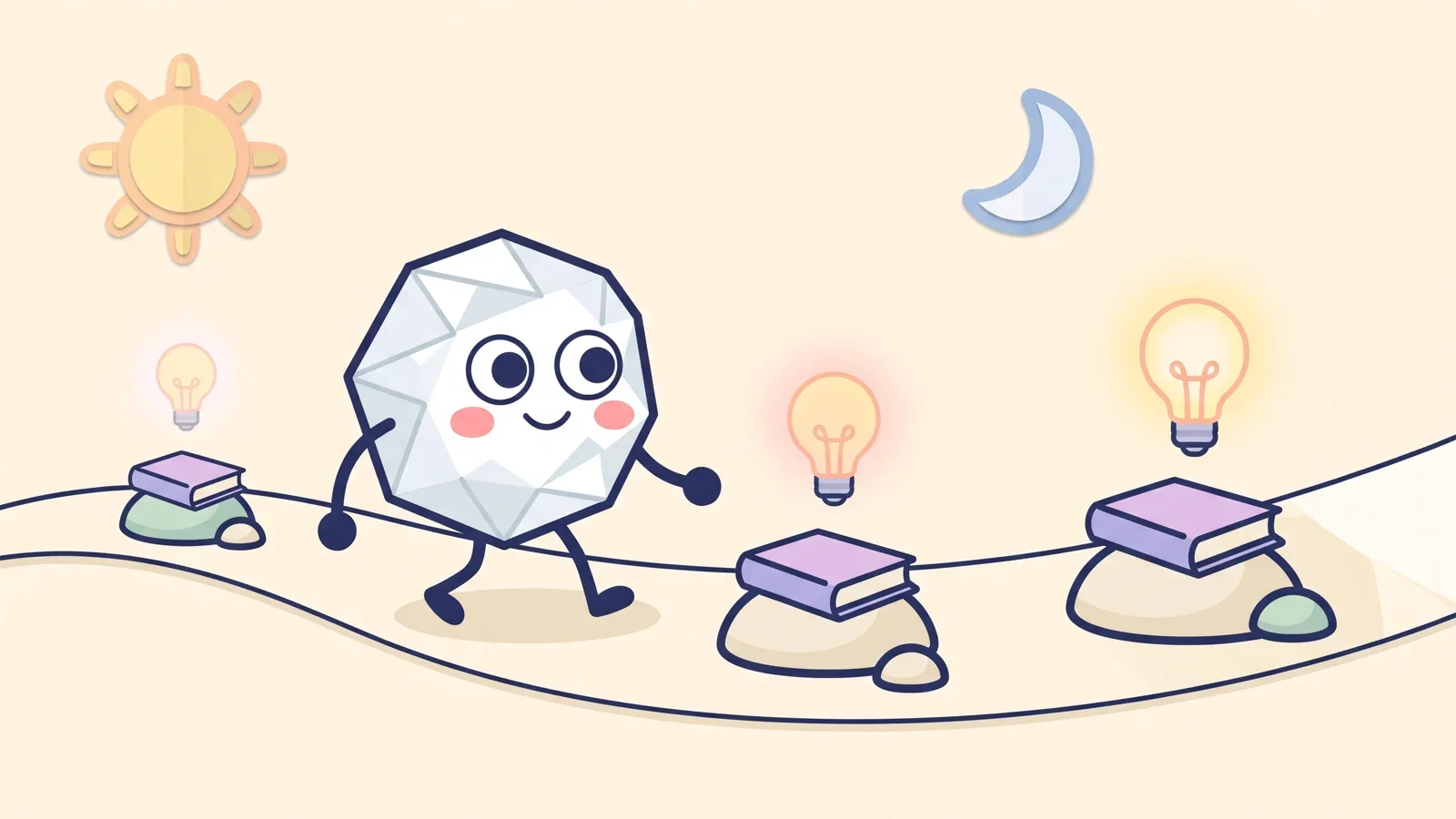
A follow-up study put rough numbers on it. More than 1,350 people learned a set of facts, reviewed them after a gap of up to 3.5 months, and were tested up to a year later. The optimal gap was about 20 to 40% of the test delay when the test came a week later, falling to about 5 to 10% when it came a year later (Cepeda et al., 2008, Psychological Science). Those participants learned trivia-style facts, not book chapters, so treat the ratios as a guide, not a formula.
For a book you want to remember for months, a reasonable schedule is: recall right after the chapter, review when you start the next reading session, then do a whole-book recall a week or two after you finish. That schedule is our suggestion built from these findings, not something a study tested on books.
How do you do a 60-second chapter recap?
Close the book, talk through the chapter from memory for about a minute, then open it and check what you missed. Here's the routine step by step. If you've used the SQ3R reading method, this is its "Recite" step, done with the book closed (University of Toronto Mississauga: Read effectively with SQ3R).
- Close the book. Put your finger in the page if you like, but don't look. The recall has to come from memory; a summary written while scanning the page is closer to the low-utility "summarization" in the 2013 review.
- Answer three questions out loud. What was the chapter's main claim? What evidence or story supported it? What do I think about it? Use your own words.
- Keep going past the easy part. When you run dry, try for one more point. That struggle is the retrieval practice. Aim for about a minute; you can stop sooner on a short chapter.
- Check, then add a correction. Open the book and skim the headings. Add one sentence on anything important you missed or got wrong. The 2006 study gave no feedback and still found large benefits, but across studies, testing helped more when people checked their answers (Rowland, 2014), and checking lets you catch mistakes before you repeat them in later recaps.
- Review before the next chapter. Next time you sit down to read, recall the previous chapter first, without looking at your recap. Listen back only afterward.
When you finish the book, do one longer recall of the whole argument, chapter by chapter, from memory. If you can't explain a chapter, that's the one to reread.
What doesn't the research show?
The evidence for retrieval practice and spacing is strong, but most of it comes from students learning short texts or facts in a lab, and it measures memory more than insight.
- Short texts, not whole books. The 2006 passages were 256 and 275 words, and the 2011 texts were short science passages. We found no research testing chapter-by-chapter recaps across a whole book.
- Mostly undergraduates. Samples were largely college students tested over days or weeks.
- Complexity is debated. Tamara van Gog and John Sweller argued that the testing effect decreases, or even disappears, as learning materials grow more complex (van Gog & Sweller, 2015, Educational Psychology Review). Karpicke and Aue replied in the same issue that "the testing effect is alive and well with complex materials" (Karpicke & Aue, 2015). Dense technical books are where results may vary most.
- Fiction is largely untested. These studies used informational texts. Recapping a novel's plot is plausible, but we found no direct evidence for it.
- Spoken versus silent recall is mixed. Word-list studies found no difference; a key-term study favored producing the answer.
- Memory isn't understanding. Remembering an argument doesn't mean you've judged it well. The "what do I think?" question is there for that reason.
How do you keep chapter recaps on your iPhone?
Record each chapter recap as its own short voice note, starting with the book's title and chapter number. For a wider capture-and-review system, see how to capture ideas before you forget them.

- Voice Memos with the Action button. Apple lists a Voice Memo action for the Action button, to "Record personal notes, musical ideas, and more"; press and hold to run it (Apple: Use and customize the Action button).
- Spitball. Record or type a thought, or set the Action button to Spitball's capture shortcut: press and hold to start, then press and hold again to save. Save one thought per chapter; each can be up to 5 minutes, plenty for a recap plus a correction. Setup for both apps is in our guide to saving a voice note with the Action button.
Spitball transcribes English on your iPhone using Apple's on-device speech capabilities, with no cloud fallback, so you can later search for a word you remember, such as the book's title. The first transcription may need a speech-model download, support varies by device, and transcripts can contain errors, especially with names; the original audio is kept (how on-device transcription works on iPhone). You can also add a photo, such as a page worth rereading. Your library stays on your iPhone by default, with optional iCloud Sync using your own Apple Account, and no Spitball account is required; see the privacy page. For every other way to record, see how to take voice notes on iPhone.
Spitball is currently in beta through Apple's TestFlight. You'll need iOS 17 or later, and beta places are limited. It's free right now and iPhone only, with a Mac app coming soon. Get Spitball. Questions? See Spitball Support or DM Nik, Spitball's developer, at @sharma on Instagram.
A FEW MORE ANSWERS
Good questions.
Why do I forget what I read so fast?
Usually because reading feels familiar while the page is open, so you don't practice retrieving the ideas later. In a 2006 study, students who only reread a passage were the most confident they'd remember it, yet a week later they recalled the least.
What is the best way to remember what you read?
Close the book after each chapter and recall the main ideas from memory, out loud or in writing, then check what you missed. Repeat that recall a few days later and again a week or two after. Retrieval practice and spaced review are the two techniques rated highest in a major 2013 review of study methods.
Should I take notes while reading?
Take notes if they help you follow the argument, but don't stop there. In a 2011 Science study, recalling a text from memory beat making concept maps with the text open, a week later, including on questions that connected several ideas, and a 2021 follow-up from the same lab, with reminders to keep connecting ideas while mapping, found the same. The most useful step is recalling the chapter with the book closed.
Is highlighting a good way to remember what you read?
Not on its own. A 2013 review of ten study techniques rated highlighting, rereading and summarization as low utility, mainly because they don't consistently improve later performance. Highlighting can mark what to review, but the review itself should be recall from memory, not rereading the yellow lines.
Does reading out loud help you remember?
It can help memory for the specific words you say, a finding known as the production effect, though one study found reading aloud helped memory but not comprehension. For remembering a chapter's ideas, recalling them aloud with the book closed is the more useful step.
How often should I review a book to remember it?
Recall each chapter right after reading, again when you start your next reading session, and once for the whole book a week or two after finishing. Research on spacing shows that gaps between reviews improve long-term retention, and the ideal gap grows the longer you want to remember.
Is saying it out loud better than thinking it?
It depends on the material. For simple word pairs, silent recall worked about as well as spoken or typed recall. For key-term definitions, producing the answer beat silent recall two days later in one set of experiments, possibly because it pushes you to retrieve the whole idea. For book chapters, speaking or writing is the safer default.
How do you remember what you read in a novel?
We found no research testing chapter recaps on fiction; the studies above used informational texts. A reasonable adaptation is to close the book after a chapter or reading session and say, from memory, what happened, why a character made the choice they did, and one scene you'd retell to a friend. Then skim the chapter to check what you missed.

WRITTEN BY
Nik Sharma
Nik is an entrepreneur, active investor, and the founder of Spitball. He writes about building businesses, practical AI, and catching ideas before they disappear.