 spitball

THE SHORT VERSION
What to take away
- To brainstorm by yourself, run three five-minute rounds: quantity first, then past the point you run dry, then with one constraint.
- In lab studies, people working alone and pooling ideas usually out-produced the same number talking it out together; written or typed group formats can close the gap.
- Groups lose ideas mainly to production blocking: only one person can talk at a time.
- The most original ideas tend to come later in a session, and people underestimate how much more they can produce.
- Choose later and deliberately: people tend to pick safe ideas over original ones, so name one of each.
WATCH THE IDEA
Solo brainstorming in three rounds
A short illustrated clip on brainstorming by yourself: set a five-minute timer and aim for quantity, keep going after you run dry because later ideas tend to be more original, add one constraint for a third round, and choose your best ideas later.
Read the video transcript
This video has no narration. Pip, the Spitball paper-ball character, sits at a desk beside a kitchen timer and tosses paper idea scraps into the air. Then two panels compare four paper balls waiting their turn at one table with four working at separate desks as their idea piles grow. Next, Pip digs in a garden bed where glowing lightbulbs lie deeper than the plain pebbles at the surface. Finally, Pip stands on a sidewalk and talks into a plain phone as paper scraps drift by. Captions: Brainstorming alone? Set a five-minute timer. Groups lose ideas waiting for a turn to talk. Round two: keep going after you run dry. Later ideas tend to be more original. Round three: add one constraint. Choose later. Pick one bold idea and one doable idea.
To brainstorm by yourself, set a timer and write or say as many ideas as you can for five minutes without judging any of them. When you run dry, keep going for another round, then add one constraint for a third. Pick the best ideas later, in a separate sitting.
This guide is for anyone who has to come up with ideas alone: a name, a plan, a fix, a first draft. It explains why solo brainstorming often beats a group meeting, which parts of the classic advice hold up, and a 15-minute, three-round session you can run anywhere. Spitball is our app, so where we mention it we've kept to what it actually does.
Every research claim links to the original paper; we checked each DOI and the numbers we quote on October 25, 2026. Apple details come from Apple's iPhone User Guide, checked the same day. Spitball details come from Spitball's published support and privacy pages.
Is it better to brainstorm alone or in a group?
For producing lots of ideas, people working alone usually do better than the same number of people brainstorming together. That finding is one of the most replicated in group research, though it compares pooled solo work with groups talking face to face, not one person against a whole team, and written or typed group formats have done better.
Brainstorming was popularized by the advertising executive Alex Osborn, who claimed, in a passage quoted by Diehl and Stroebe, that "the average person can think up twice as many ideas when working with a group than when working alone." In 1958, researchers tested that claim by having people brainstorm for 12 minutes either alone or in four-person groups (Taylor, Berry & Block, 1958, Administrative Science Quarterly). To compare fairly, the researchers pooled the ideas of four people who had worked alone, counting duplicates once. Researchers call that pooled set a nominal group: several people brainstorming separately, with their ideas pooled and duplicates counted once. The nominal groups produced nearly twice as many different ideas as the real ones.
Later studies kept finding the same thing. When Michael Diehl and Wolfgang Stroebe reviewed the literature in 1987, 18 of the 22 experiments they listed found nominal groups more productive than real groups, and the four that found no difference all used pairs (Diehl & Stroebe, 1987, Journal of Personality and Social Psychology). A 1991 meta-analysis concluded that brainstorming groups were less productive than nominal groups for both the quantity and the quality of ideas, with bigger losses in bigger groups (Mullen, Johnson & Salas, 1991, Basic and Applied Social Psychology).
Group members rarely notice. In a 1993 survey, most people said they would come up with more ideas in a group than alone, and in a follow-up experiment, people who brainstormed in groups rated their own performance more favorably than people who brainstormed alone. The authors called this the illusion of group productivity (Paulus et al., 1993, Personality and Social Psychology Bulletin).
Why do groups come up with fewer ideas?
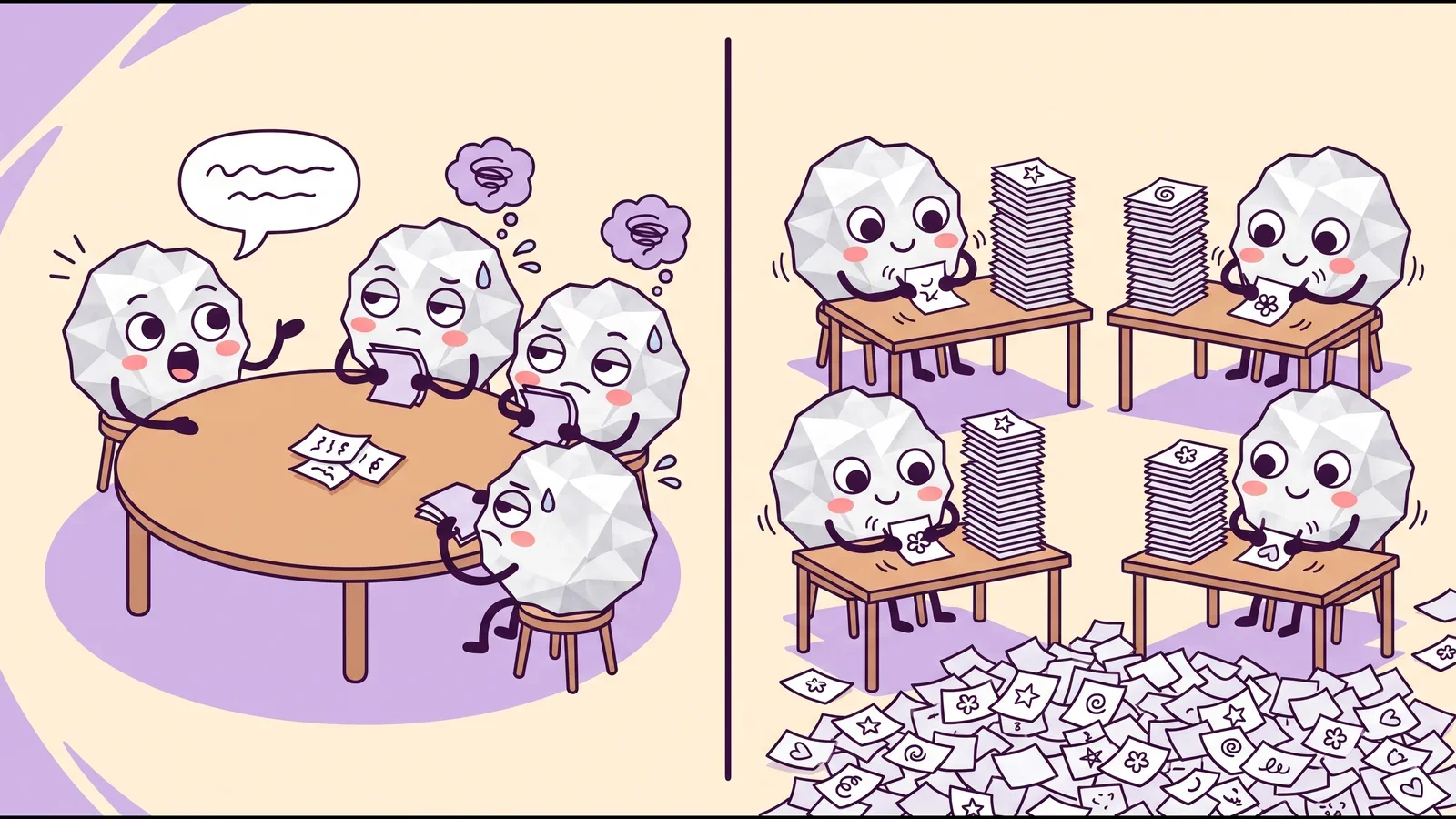
Mainly because only one person can talk at a time. While you wait your turn, you forget ideas, drop them, or get pulled along by someone else's train of thought. Researchers call this production blocking.
Diehl and Stroebe tested three explanations: blocking, free riding (letting others do the work) and evaluation apprehension (fear of being judged). In their fourth experiment, 60 psychology students at the University of Tübingen brainstormed for 15 minutes on how to reduce unemployment in Germany. Four-person groups that talked face to face produced about 56 distinct ideas on average. Four people working separately, with their ideas pooled, produced 106.
The telling conditions sat in between. Some participants worked in separate rooms with a panel of lights and could speak only when nobody else's light was on. Their output was at group levels, about 38 to 46 ideas, even when they couldn't hear each other's ideas. Others had the same lights but could speak whenever they liked, and they produced about 103. The authors concluded that blocking accounted for most of the gap.
Being judged mattered too, even alone. In their second experiment, people brainstorming by themselves produced fewer ideas when told that peers or judges would evaluate their performance. That study tested expecting other people's judgment, not self-criticism, and a third experiment found evaluation worries didn't explain the group gap. Still, it's a reason to keep judging out of the generating rounds.
How do you brainstorm by yourself, step by step?
Run three short, timed rounds with a different job for each, and keep judging out of all three. This 15-minute structure is our suggestion, built from the studies in this guide; no study tested it as a package.
- Write the question as a "How might I…?" prompt. One sentence, specific enough to answer. "How might I get more neighbors to the spring cleanup?" works better than "community ideas."
- Round 1, five minutes: quantity only. List or say every idea, including obvious and silly ones, one line each. Don't stop to evaluate.
- Round 2, five minutes: past the point where you ran dry. When ideas slow down, keep going. The next section explains why this round tends to produce the more original ideas.
- Round 3, five minutes: add one constraint. Pick a rule such as "no budget," "only things a kid could do," or "it must happen in one hour," and generate again.
- Stop and walk away. Do something else before you choose. If a walk helps, we cover the research on that in why your best ideas come in the shower.
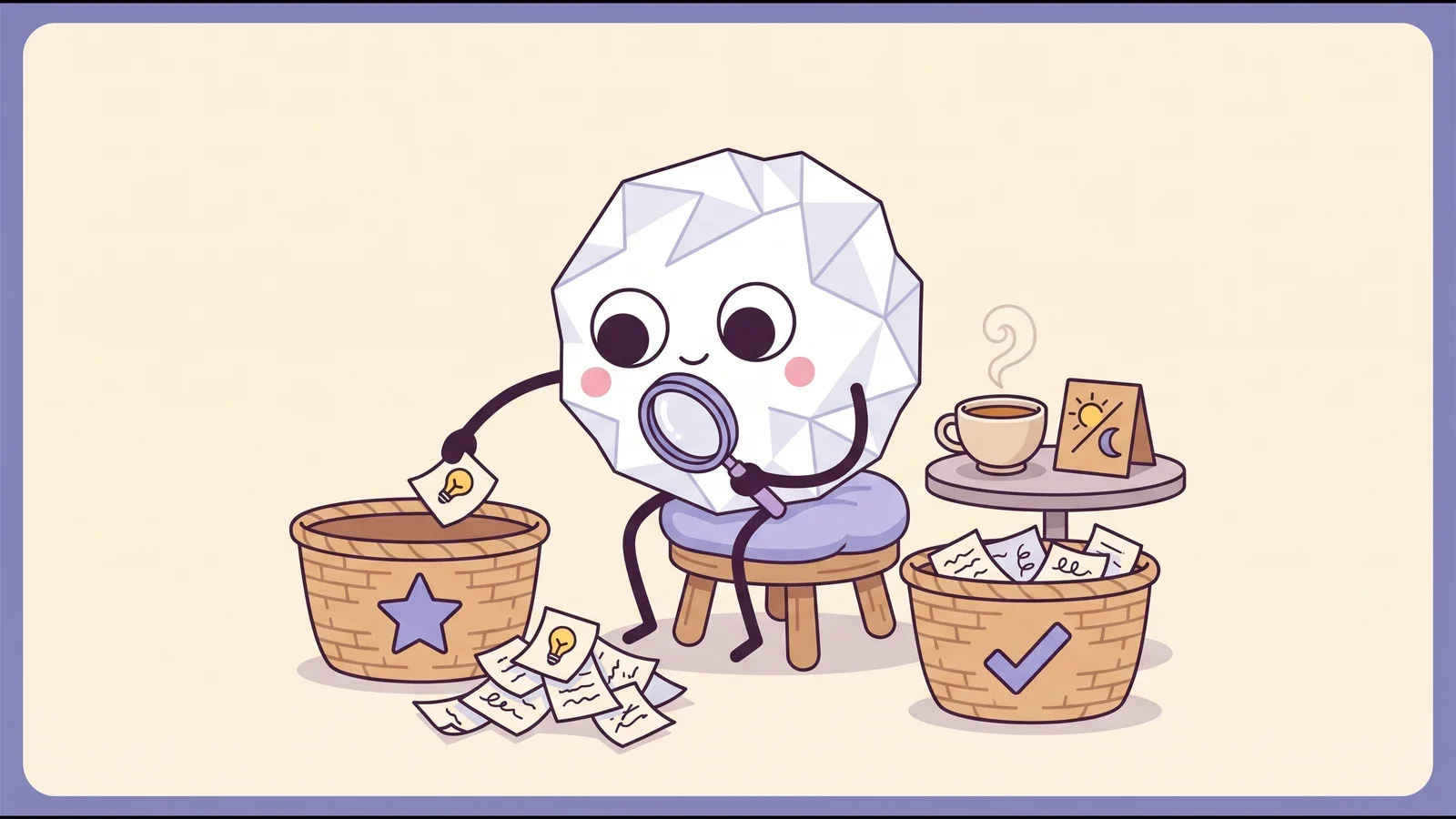
- Choose later, on purpose. Come back and pick two: the most original idea and the most workable one.
In the cleanup example, Round 1 might produce the expected list: flyers, a group chat post, free coffee. Round 2 is where stranger options appear, like a prize for the weirdest piece of litter. Round 3, with "no budget," might give you asking the local school to count it as volunteer hours.
Should you aim for quantity or quality?
Aim for quantity. Telling people to generate as many ideas as possible produced more ideas, and more good ideas, than telling them to focus on quality.
Paul Paulus and colleagues gave brainstormers one of four instructions: no specific goal, a quantity goal, a quality goal, or both. The quantity goal led to more ideas and more good ideas than the other instructions (Paulus, Kohn & Arditti, 2011, Journal of Creative Behavior).
That fits the first of Osborn's original rules, as summarized by Diehl and Stroebe: the more ideas the better, the wilder the better, combine and improve ideas, and don't criticize. The rule to drop is the hidden one most of us follow alone: only writing an idea down once it seems good enough.
Why do your best ideas come late in a session?
Because the obvious ideas come first. In studies of timed idea generation, people produced the most ideas early, but the most creative ones tended to come later, once the easy answers were used up.
Roger Beaty and Paul Silvia gave 133 young adults a 10-minute task: list unusual uses for a common object. The number of ideas peaked in the first minute and then dropped sharply, but rated creativity rose sharply over the session, levelling off slightly at the end. The effect was smaller among people who scored higher on a test of fluid intelligence (Beaty & Silvia, 2012, Psychology of Aesthetics, Creativity, and the Arts). Researchers call this the serial order effect.
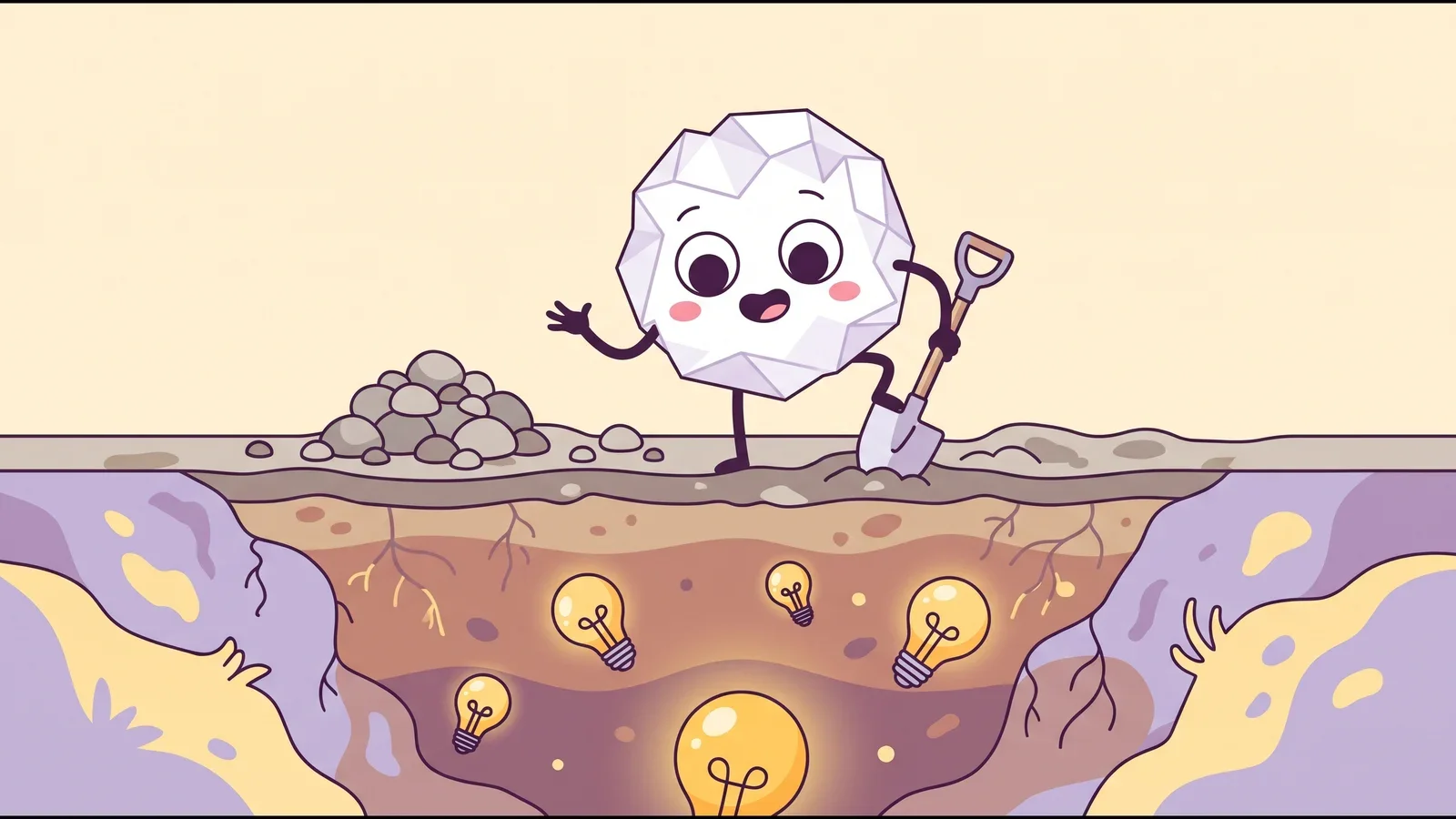
We also give up too early. Brian Lucas and Loran Nordgren asked 24 Northwestern students to list original things to eat or drink at Thanksgiving for 10 minutes, then predict how many more they could produce in another 10. They predicted about 10 and produced about 15, and the later ideas were rated slightly more original (1.88 vs 1.76 on a 3-point scale). Across seven studies, people consistently underestimated the value of persisting, apparently because creative thinking feels hard when it's going slowly. Even sketch comedians, most of them professional or aspiring professional comedians, underestimated how many more comedy-sketch endings they would come up with (Lucas & Nordgren, 2015, Journal of Personality and Social Psychology).
That's the case for Round 2. The moment you feel empty is a poor signal that you're done.
Do constraints help you come up with ideas?
Sometimes. A well-chosen constraint can push you away from the first, most familiar answers, but the research on constraints is mixed, so treat Round 3 as an experiment.
Catrinel Haught-Tromp named her 2017 study after Green Eggs and Ham, which Dr. Seuss wrote using only 50 different words. In her first study, undergraduates wrote short greeting-card rhymes; when a rhyme had to include a given concrete noun, such as "dog" or "kite," judges rated it more creative than the same people's free rhymes. Participants who did the constrained rhymes first also wrote more creative free rhymes than a separate group who did the free ones first. A second study, where people picked their own nouns, found the same pattern. The study rated single rhymes, not how many ideas people had, and the author notes the carryover may be specific to the rhyming task (Haught-Tromp, 2017, Psychology of Aesthetics, Creativity, and the Arts).
A broader review is more cautious. Looking across research on constraints in creativity and innovation, Oguz Acar, Murat Tarakci and Daan van Knippenberg described the research as fragmented, with conflicting findings, and noted that different kinds of constraint, from deadlines to scarce resources, work through different mechanisms (Acar, Tarakci & van Knippenberg, 2019, Journal of Management). One constraint per round keeps the test small.
If you stall, a prompt list can supply constraints. SCAMPER asks you to substitute, combine, adapt, modify, put to another use, eliminate or reverse part of an idea. Treat it as a checklist of prompts; the studies in this guide didn't test it.
Other solo techniques work the same way: they give you a structure for producing more before you judge. Freewriting means writing nonstop for the whole round and highlighting usable lines afterward. Mind mapping means putting the question in the middle of a page and branching ideas outward. We found no research showing that either reliably beats a plain timed list, so use whichever keeps you producing.
How do you pick the best idea afterward?
Separately, and deliberately. People are much better at generating original ideas than at choosing them, and left to themselves they tend to pick the safe ones.
In a 2006 study, Eric Rietzschel, Bernard Nijstad and Wolfgang Stroebe had nominal and real groups generate ideas and then choose their best. Nominal groups (three people working alone) again produced more ideas, and more original but less feasible ones, but there were no differences in the quality of the ideas they chose, and selection overall was no better than chance (Rietzschel, Nijstad & Stroebe, 2006, Journal of Experimental Social Psychology).
A 2010 follow-up pointed to a reason. People chose ideas that seemed feasible and desirable at the expense of originality. When explicitly told to pick creative or original ideas, they chose more original ones, but they were less satisfied with their choices, and the chosen ideas were rated as less effective (Rietzschel, Nijstad & Stroebe, 2010, British Journal of Psychology).
That's why the last step asks for two picks. Name the most original idea and the most workable one, then ask whether the original one can be made workable. If you only pick once, you will probably pick the safe one.
When should you bring other people in?
After you've worked alone. Studies of "hybrid" brainstorming suggest the strongest pattern is solo generation first, then sharing and building in a group.
Karan Girotra, Christian Terwiesch and Karl Ulrich compared two processes with 44 University of Pennsylvania students in a product design course, who had been trained in idea generation. In the team version, groups of four brainstormed together for 30 minutes. In the hybrid version, people worked alone for 10 minutes and then met in groups of four for 20. The hybrid groups generated more ideas and better ideas, and were better at recognizing which of their ideas were best. Building on other people's ideas, a classic brainstorming rule, didn't produce better ideas (Girotra, Terwiesch & Ulrich, 2010, Management Science).
Alternating can help too. Across three experiments, Runa Korde and Paul Paulus found that alternating between solo and group sessions produced the most ideas: clearly more than group-only sessions and, pooling all three experiments, more than solo-only work. The benefit showed up in the solo sessions after people had heard others' ideas (Korde & Paulus, 2017, Journal of Experimental Social Psychology). Your solo rounds are worth doing even when a meeting is coming.
If you do meet, change how ideas are shared. The shortfall comes mostly from waiting to speak, and formats that remove the wait have done better. In one study, students in four-person groups who silently wrote ideas on slips of paper and passed them around (brainwriting) came up with more distinct uses for a paper clip in 15 minutes than four students writing alone, about 86 versus 61 (Paulus & Yang, 2000, Organizational Behavior and Human Decision Processes). In a test of electronic brainstorming, 12-person groups typing into a shared system out-produced 12 people working alone, though six-person groups did no better (Dennis & Valacich, 1993, Journal of Applied Psychology).
What doesn't the research show?
The evidence is strong that pooled solo work out-produces group brainstorming in the lab. It's thinner on how one person should run a session in real life.
- Nominal groups, not lone geniuses. Most comparisons pit several people working alone, with ideas pooled, against the same number working together. They don't show that one person beats a team. And when groups wrote or typed ideas instead of speaking, the gap shrank or reversed.
- Short lab tasks and students. Sessions ran 10 to 30 minutes, often on tasks like unusual uses for an object, mostly with undergraduates. Diehl and Stroebe's fourth experiment had only three groups per condition.
- Counting ideas isn't the same as solving a problem. Most studies measure the number of ideas and judges' ratings, not whether an idea worked once implemented.
- Constraints are mixed. Two rhyme-writing experiments found a benefit for one kind of constraint (including a set word); a broad review found conflicting results across kinds such as deadlines and budgets. We found no research testing a 'no budget' style constraint in a solo brainstorming round.
- Spoken versus written is untested alone. In the 1991 meta-analysis, the group shortfall was larger when ideas were spoken aloud and tape-recorded rather than written, but that's a finding about groups. We found no research showing that speaking ideas alone produces more or better ideas than writing them.
- Our three-round session is a synthesis. Each step draws on a study above, but no study tested the combination.
How do you run solo brainstorming rounds on your iPhone?
Use a timer, and capture each round as its own note so you can review them together later. Speaking can be quicker than typing, and talking an idea through out loud can sharpen it. To fit sessions into a weekly capture-and-review habit, see how to capture ideas before you forget them.
- Voice Memos with the Action button. Apple lists a Voice Memo action for the Action button, to "Record personal notes, musical ideas, and more"; press and hold to run it (Apple: Use and customize the Action button).
- Spitball. Record or type a thought, or set the Action button to Spitball's capture shortcut: press and hold to start, and again to save. Each thought can be up to 5 minutes, which matches one round. Setup for both apps is in our guide to saving a voice note with the Action button.
Spitball transcribes English on your iPhone using Apple's on-device speech capabilities, with no cloud fallback, so when you sit down to choose, you can search for a word you remember from a round. The first transcription may need a speech-model download, support varies by device, and transcripts can contain errors, especially with names; the original audio is kept (how on-device transcription works on iPhone). You can also add a photo or a place, such as the spot where a round happened. Your library stays on your iPhone by default, with optional iCloud Sync using your own Apple Account, and no Spitball account is required; see the privacy page. For every other way to record, see how to take voice notes on iPhone.
Spitball is currently in beta through Apple's TestFlight. You'll need iOS 17 or later, and beta places are limited. It's free right now and iPhone only, with a Mac app coming soon. Get Spitball. Questions? See Spitball Support or DM Nik, Spitball's developer, at @sharma on Instagram.
A FEW MORE ANSWERS
Good questions.
Is it better to brainstorm alone or in a group?
For generating many ideas in a spoken session, usually alone. In decades of lab studies, people who brainstormed separately and pooled their ideas produced more, and often better, ideas than the same number talking together. Groups that write or type their ideas instead of taking turns to speak have matched or beaten solo work in some studies, and individual-then-group hybrids generated more and better ideas than teams in one study.
What are the four rules of brainstorming?
Alex Osborn's classic rules are: the more ideas the better, the wilder the better, combine and improve ideas already suggested, and don't criticize during the session. Research supports aiming for quantity, and people produced fewer ideas when they expected others to judge them. One study found that building on others' ideas didn't produce better ideas.
How long should a solo brainstorming session be?
There's no proven ideal length. Studies typically ran 10 to 30 minutes. A practical approach is three five-minute rounds, about 15 minutes in total, because the more original ideas tend to come after the easy ones run out, and people underestimate how much more they can produce by persisting.
What should you do when you run out of ideas?
Keep going a little longer before stopping. In one study, students predicted about 10 more ideas in a second 10-minute stretch but produced about 15, and the later ideas were rated slightly more original. If you're truly stuck, add one constraint, such as a budget of zero, and start a fresh round.
What are some techniques for brainstorming by yourself?
Common solo techniques include timed listing, freewriting (writing nonstop and highlighting useful lines afterward), mind mapping (branching ideas out from a central topic) and prompt lists such as SCAMPER. The studies in this guide mostly tested timed listing; we found no research showing that any one of the others reliably beats it. Pick one, set a timer and keep judgment for later.
How do you choose the best idea after brainstorming?
Choose in a separate sitting and pick two: the most original idea and the most workable one. Studies found people tend to select feasible ideas over original ones, and in one study selection was no better than chance. Being told to look for originality helped people pick more original ideas, though they were less satisfied with those picks.
Can you brainstorm by talking out loud?
Yes. Speaking can be faster than writing, and recording each round lets you review it later. We found no research showing that spoken solo brainstorming produces more or better ideas than writing, so use whichever keeps up with your thinking. In group studies, waiting to speak was what cost ideas.
WRITTEN BY
Nik Sharma
Nik is an entrepreneur, active investor, and the founder of Spitball. He writes about building businesses, practical AI, and catching ideas before they disappear.