 spitball
THE SHORT VERSION
What to take away
- Fillers like um and uh are normal and tend to show up while you plan what to say next; a few at a natural rate even helped listeners recall stories in lab tests.
- Record a one- to two-minute answer, replay the audio and count fillers per minute by ear, noting where they cluster.
- Swap the habit for a brief pause at a sentence end or between points: in several small studies, learning to spot each filler, alone or with a pause, cut fillers.
- Rehearse first lines and transitions for talks, and allow a thinking pause in interviews.
- Aim for fewer fillers, not zero, and recount weekly from the audio, not a transcript.
WATCH THE IDEA
Swap your ums for pauses in four moves
A short illustrated clip on saying um less in four moves: record a one- to two-minute answer, replay it and count your fillers by ear, pause instead of saying um when you feel one coming, then record again and recount.
Read the video transcript
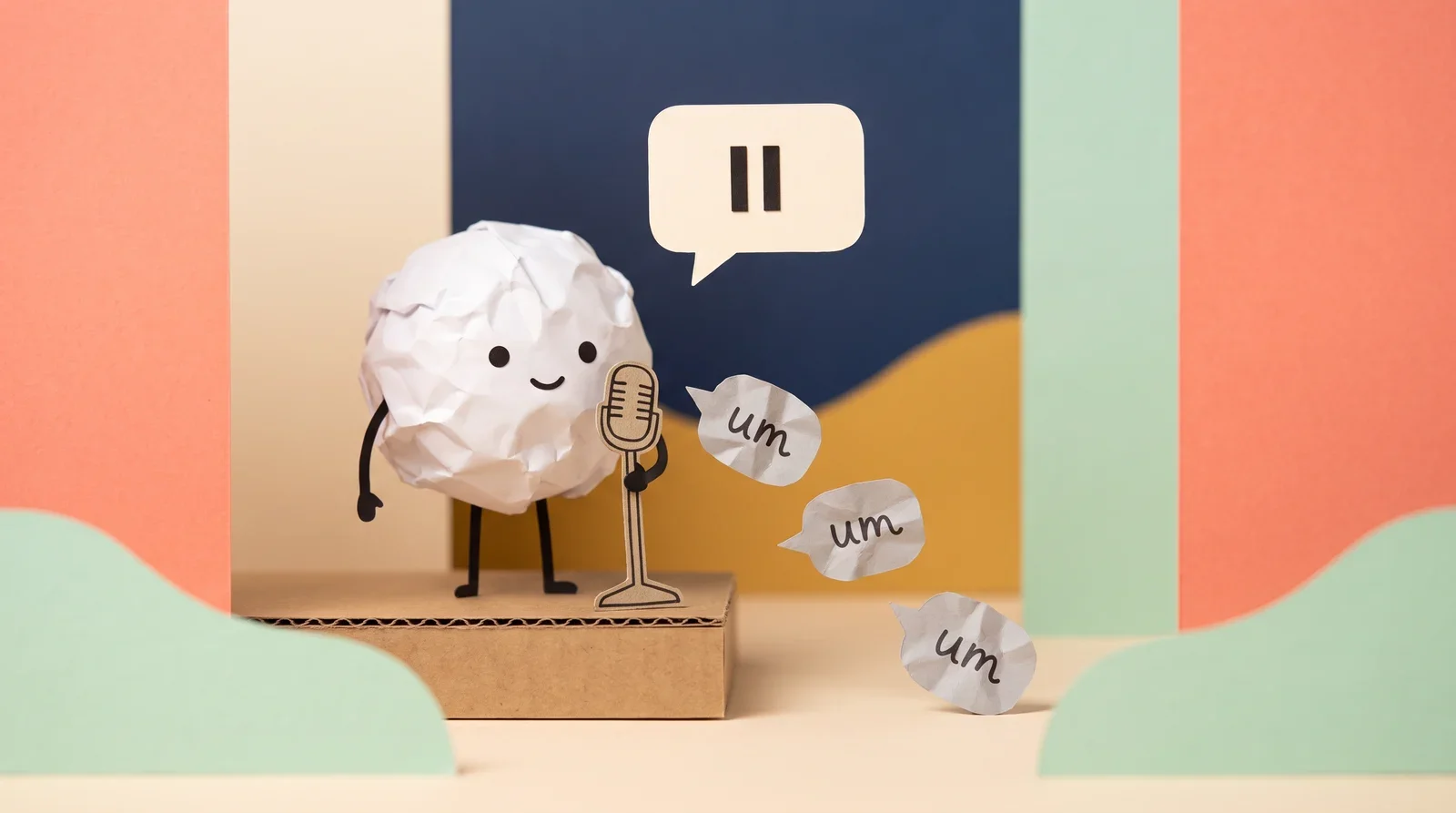
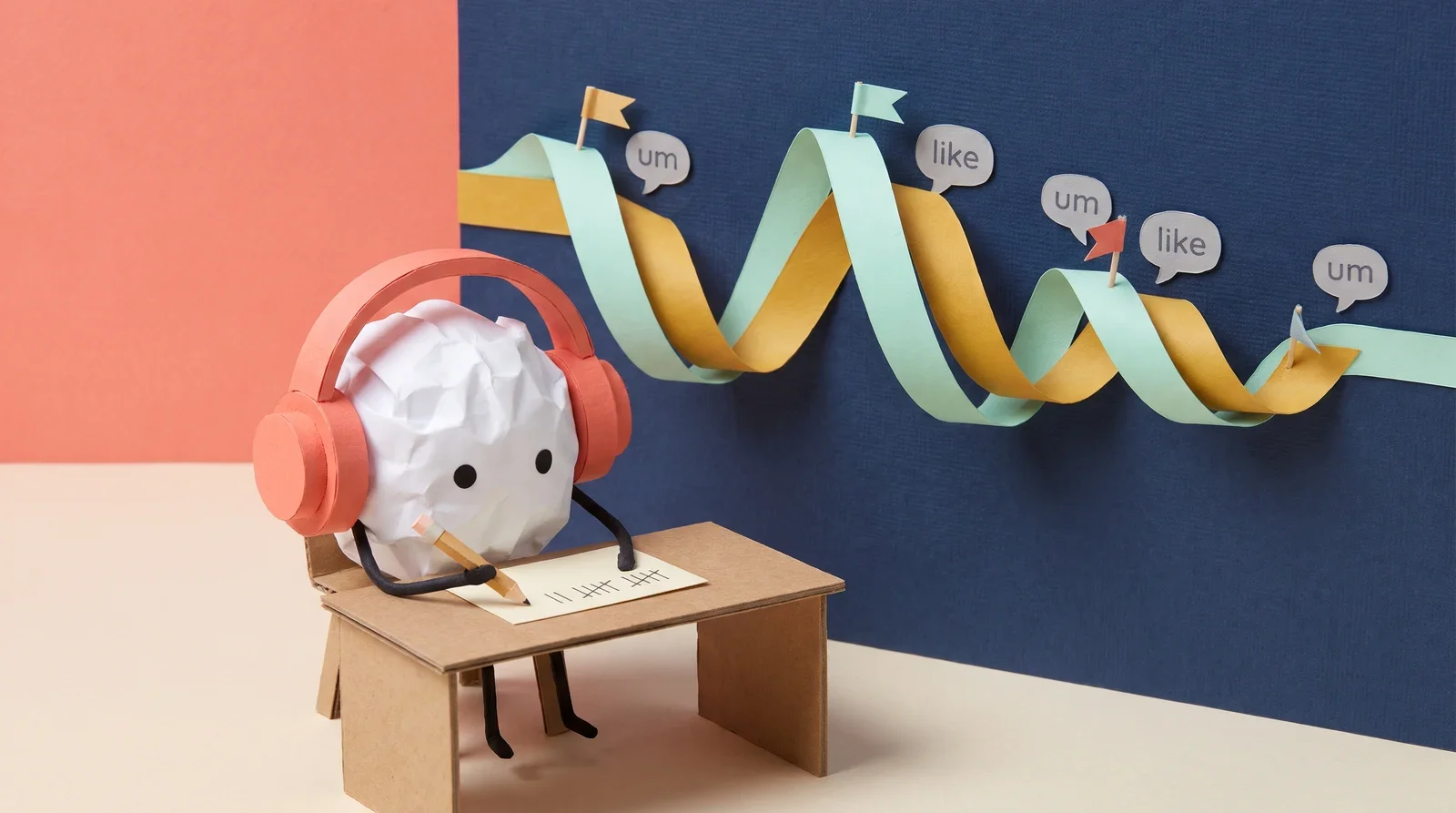
This video has no narration. Pip, the Spitball paper-ball character, talks into a vintage paper microphone on a small cardboard stage as crumpled paper scraps tumble around it. Next, Pip wears coral paper headphones at a tiny desk, listening and making pencil tally marks while a paper sound wave ripples behind it. Then Pip walks a winding coral paper path and sits on a bench shaped like a pause symbol. Finally, Pip speaks calmly on a small stage to a row of paper audience figures and opens its arms. Captions: Saying um a lot? Start by hearing it, not fighting it. Record a one to two minute answer, then replay the audio. Count every um, uh and filler like by ear. When you feel one coming, close your mouth and pause. Let a silent pause do the job the um was doing. Record again and recount. Aim for fewer, not zero.
To stop saying "um," first find out how often and where you say it: record a one- to two-minute answer, replay the audio and count every filler by ear. Then practice one swap. When you feel an "um" coming, close your mouth and pause instead. Aim for fewer fillers, not zero.
This guide is for anyone who has heard a recording of themselves and winced at the "um"s, whether before a presentation, a job interview or a podcast. It covers why fillers happen, what research says about whether they hurt, the small studies that trained people out of them, and a one-week practice plan. Spitball is our app, so where we mention it we've kept to what it actually does.
Research claims link to the original papers; we checked each one on October 28, 2026. The week plan and the tips labeled as ours are our suggestions, built from those findings, not a tested program.
Why do people say "um" and "uh"?
Mostly because they're planning what to say next. "Um" and "uh" tend to show up while you search for a word or decide how to go on; they aren't random noise.
That's the conclusion of an influential paper by Herbert Clark and Jean Fox Tree. Working from large collections of recorded everyday conversation, they argued that speakers use "uh" to announce a minor delay and "um" to announce a major one, and that both are conventional English words that speakers choose, not just sounds that slip out (Clark & Fox Tree, 2002, Cognition). In their account, the delays come from searching for a word, deciding what to say next, and wanting to keep the floor or hand it over. In earlier listening experiments in English and Dutch, Fox Tree found that hearing "uh" helped people recognize words in the speech that followed, while hearing "um" neither helped nor hurt, which she read as support for the short-versus-long-delay idea (Fox Tree, 2001, Memory & Cognition).
Not everyone agrees. When two other researchers measured the actual silences after "uh" and "um" in six of Hillary Clinton's media interviews, most fillers weren't followed by any pause at all, the pauses that did follow "um" were too short to count as major delays, and pause lengths after the two almost entirely overlapped (O'Connell & Kowal, 2005, Journal of Psycholinguistic Research). They measured the silences acoustically, where Clark and Fox Tree relied on how professional coders had perceived and marked the pauses. Treat "um means a longer delay" as one influential account, not settled fact.
Two practical things follow:
- Fillers cluster where planning is hardest. Watch the start of an answer, the move from one point to the next, and the moment before a name or a number.
- Some of them do a job. An "um" can tell the listener "I'm not done yet, hold on." That's why the fix in this guide replaces the sound with a pause, rather than trying to talk faster to fill every gap.
If you say "um" a lot, it doesn't mean you're unprepared or nervous. It usually means you're thinking while you talk, which is what speaking off the cuff involves.
Are filler words actually bad?
Not always. In listening experiments, a few fillers at a natural rate helped people remember what they heard. Whether fillers change how listeners judge you is a separate question, and the one study we cite on it gives a mixed answer (more below).
- Recall of short stories. In Scott Fraundorf and Duane Watson's first experiment, 72 native English-speaking undergraduates heard three recorded stories of about 300 words, each in a different version: fluent, with six "uh"s and "um"s spliced in, or with coughs of the same length in the same places. People recalled the story with fillers better than the fluent one, while the coughs made recall worse. The benefit covered the whole story, not just the parts right after a filler (Fraundorf & Watson, 2011, Journal of Memory and Language).
- Location didn't matter. In their second experiment, fillers helped whether they were placed where speakers usually say them or in unusual spots. The authors suggest fillers make listeners pay more attention.
- Words after a hesitation. In a brain-recording study, words that followed an "er" were more likely to be recognized in a later memory test than words heard without one (Corley, MacGregor & Donaldson, 2007, Cognition).

Keep the scope in mind. These were short recordings with a handful of fillers, in a lab, mostly with students. They don't test a talk full of them.
Research on how listeners judge a speaker is thinner. In one study, audiences heard a recording of the same talk in one of three versions: the original with its "um"s, an edit with each "um" replaced by silence, or an edit with the "um"s cut out entirely. On ratings of the speaker, the version with no pauses came out best, and the version with the "um"s was rated better than the one with silences in their place. The "um"s affected ratings even in conditions where listeners couldn't report that they were there. A questionnaire in the same paper found that the average listener assumes "um"s mean a speaker is anxious or unprepared, though the author notes they don't seem to come from either (Christenfeld, 1995, Journal of Nonverbal Behavior). That's one edited recording of one talk, so it doesn't show that every "um" costs you, and it doesn't make them free either. The fair takeaway is narrower: an occasional "um" is normal and can even help a listener. The goal is to cut the habitual ones, not every one.
How do you find your filler words?
Record yourself answering a real question for one to two minutes, then replay the audio and count every filler by ear. You can't fix a habit you can't hear, and most people hear far more fillers on playback than they noticed while talking.
Here's the routine we suggest:
- Pick a real prompt. "Walk me through your last project," "Tell me about yourself," or the opening of a talk you have coming up. Answer without notes, as you would on the day.
- Record one to two minutes. Long enough for your habits to show, short enough to replay right away.
- Replay and tally. Make a mark for every "um," "uh" or "er," and a separate column for word fillers like "like," "you know," "basically," "so" at the start of a sentence, or "right?" at the end.
- Note where they land. Mark whether each one came at the start, between points, or before a specific word.
- Work out your rate. Divide the total by the minutes you spoke. That number is your baseline.
Count from the audio, not from a transcript. Speech-to-text may leave out or tidy up fillers, so a clean-looking transcript can hide the habit you're trying to hear.
If you belong to a Toastmasters club, this is the Ah-Counter's job at each meeting: logging the filler sounds, overused words and overlong pauses that speakers rely on, then reporting them back (Toastmasters' Ah-Counter role). Your recording does the same job on your own.
Spotting your own fillers is also the first step in the study below. Before learning anything else, participants watched a three-minute video of their own speech and identified each filler they used.
What does the research say works to stop saying "um"?
The best-tested method we found is called simplified habit reversal: learn to notice each filler as it happens, then practice a replacement behavior in its place. For "um" and "uh," the replacement was a short silent pause.
Carolyn Mancuso and Raymond Miltenberger worked with six female university students. Each gave three- to five-minute impromptu speeches to a researcher. The full method and results are in Mancuso's master's thesis (Mancuso, 2013, University of South Florida), with a shorter report in the journal paper (Mancuso & Miltenberger, 2016, Journal of Applied Behavior Analysis):
- Awareness training. After identifying fillers in a video of their own speech, participants gave practice speeches and raised a hand each time they used a filler, or were about to.
- A competing response. For "um," "uh" and "er," they paused silently for about three seconds instead. For "like," they restarted the sentence without it.
- Short training. Training took a single session of 60 to 90 minutes. One participant needed a booster session.
All six used fewer fillers afterward. Across the group, combined fillers fell from an average of 7.38 a minute at baseline to 1.43 a minute after training, and the lower rates held at follow-up checks two to five weeks later. Four of the six cut their rate by at least 80% in their first speech using the pause, which led the authors to suggest awareness alone might do much of the work.
Later small studies, each measuring the same people before and after training, tested that. Awareness training alone, meaning learning to describe and spot your own fillers with no replacement behavior, cut filled pauses, tongue clicks and filler "like"s for all four university students in one study. All four needed booster sessions for further gains, and the drop generally held in speeches to a small audience (Spieler & Miltenberger, 2017, Journal of Applied Behavior Analysis). In another, awareness training alone worked for every participant without booster sessions (Montes, Heinicke & Geierman, 2019, Journal of Applied Behavior Analysis). In a third, four students got awareness training plus instructions to use a silent pause. All four used fewer fillers afterward, and for one of them the drop carried over to a presentation in front of a class. The authors read the earlier studies as suggesting that adding the pause may work better than awareness alone (Pawlik & Perrin, 2020, Journal of Applied Behavior Analysis).
These are all small studies, and most participants spoke to one researcher rather than an audience, so treat this as a promising method, not proof it will work for everyone.
How do you replace "um" with a pause?
Close your mouth at the moment you'd say "um," take a brief breath, and start the next phrase when it's ready. The pause does the job the "um" was doing, buying you time, without the sound.
The study used a three-second pause as a training drill. In real speech, a shorter pause is usually enough; play your recordings back and judge what sounds natural. Our suggestions for practicing the swap:
- Feel for the cue. Most people notice a small intake of breath or a "searching" feeling just before a filler. That's the moment to close your lips.
- Finish sentences with a full stop. Many fillers sit on "and um" or "so um" joins. End the sentence, pause, and start a new one.
- Pause on purpose at transitions. If you plan a pause between points, there's no gap for a filler to fill.
- Slow down a little. Speaking a touch slower gives you more planning time inside the sentence. This is our suggestion, not a finding from the study.
- Restart instead of filling. If you lose the sentence, stop and say it again from the beginning, the same move the study used for "like."

The pause will feel long to you at first. Listen back to a recording before deciding it's too long. The training study drilled a silent pause of about three seconds during practice speeches. In front of listeners, keep it shorter: in the editing study above, the version with silence in place of each "um" was rated below the version with the "um"s, and the version with no gaps was rated best. Aim for a brief pause at the end of a sentence or between points, where you'd breathe anyway, not a long gap in the middle of a sentence.
How do you stop saying "um" when presenting or public speaking?
Rehearse your opening and your transitions out loud until you can say them without searching, then plan your pauses at those spots. Those are the places fillers tend to gather in a prepared talk.
- Script your first line. The first sentence is where a lot of people reach for "um" or "so." Know it cold.
- Learn transitions as lines. Write the sentence that moves you from one section to the next, and practice it on its own.
- Pause on a slide change. Click, look at the slide, pause, then speak.
- Run it once, recorded, then count. Count your fillers per minute in a full run-through, fix the spots where they cluster, and run it again.
For a full rehearsal routine, including breaking a script into sections and practicing in front of someone, see our guide to rehearsing a speech out loud.
How do you stop saying "um" in interviews?
Give yourself permission to think before you answer, and say so if you need to. A brief pause after the question, before your first sentence, lets you start your answer cleanly instead of with a string of "um"s.
Our suggestions:
- Buy time with a real sentence. "Let me think about that for a second," then pause. Use it once or twice, not as a new filler.
- Start with the answer. Open with a one-sentence answer, then the example. A clear first sentence leaves less room for fillers at the start.
- Practice the common questions out loud. Record yourself answering "Tell me about yourself" and two or three questions you expect, then count. If you want to know why practicing out loud can help more than running an answer in your head, see what the research says about thinking out loud.
- Don't aim for zero. One or two fillers in an answer are normal. The goal is that they don't distract from what you're saying.
How do you stop saying "like" and "you know"?
Use the same two steps, whether in a talk or in everyday conversation: catch each one on playback, then replace it. For "like," the study's replacement was to stop and restart the sentence without it, and that works for "you know" and "basically" too.
Not every "like" is a filler. "It looks like rain" and "apps like Voice Memos" use the word properly. The ones to count are the ones you could delete without changing the meaning, such as "it was, like, really good." When you hear yourself start one, finish the phrase without it or begin again. A few word fillers have quick swaps you can try: "for example" or "such as" when you're introducing an example, and a full stop instead of "you know?" at the end of a point.
Word fillers can be harder to hear than "um" because they sound like real words. Give them their own column in your tally so they don't hide among the rest.
What does a week of filler-word practice look like?
Here's our suggested plan, built from the awareness-then-replace method above. It takes about ten minutes a day.
- Day 1: Baseline. Record a two-minute answer to a real prompt. Replay it and count fillers per minute, noting where they land. Save the recording.
- Day 2: Hear them. Record a new answer, replay it, and say "there" out loud at each filler.
- Day 3: Catch them live. While you speak, tap a finger on the table each time you say a filler, or feel one coming. This is our adaptation of the study's hand raise.
- Day 4: Swap in the pause. Record another answer. Each time you feel one coming, close your mouth and pause.
- Day 5: Target your hot spots. Practice the places your Day 1 count showed fillers gathering, such as first lines or transitions.
- Day 6: Use it for real. Try the pause in a meeting, a call or a conversation. Don't count; just notice.
- Day 7: Recount. Record the same prompt as Day 1, count, and compare the two rates.
If your rate has dropped, keep a weekly check: one recorded answer, one count. If it hasn't, go back to Days 2 and 3. Noticing is the step most people skip.
What doesn't the research show?
The studies here explain why fillers happen and test one way to reduce them. They leave several questions open.
- Small studies only. The training evidence is a handful of single-case studies, each following a few university students (four to six in the ones whose abstracts or reports give a number) and measuring the same people before and after training. A 2022 review counted seven such studies published in one journal between 2016 and 2022 (Luiselli, 2022, Journal of Applied Behavior Analysis). We found no large trial comparing trained and untrained groups. One partial replication with four social-work students couldn't show the training caused the drop, because three of the four were already using fewer fillers during the baseline recordings, before training began (Bördlein & Sander, 2020, Research on Social Work Practice).
- Little real-audience testing. Most participants spoke to one researcher. Some studies added checks in front of a small audience, and in one, the drop carried over to a class presentation for one of four students (Pawlik & Perrin, 2020). In the studies we checked, none followed people into meetings or interviews.
- Fewer fillers isn't better speaking. In the Mancuso study, raters who didn't know which speeches came before or after training scored participants' fillers as improved, but saw little or no change on 11 of 12 other items, including confidence and overall speaking ability. In the 2017 awareness-training study, participants said their overall public speaking had improved, but that was their own rating.
- Listening studies used light filler use. The recall studies tested a few fillers at a natural rate in short recordings, not heavy use. The one judgment study we cite edited a single recorded talk, so it doesn't tell you how a live audience would rate you.
- Advice isn't evidence. Much of what's written on fillers, including expert tips such as a 2022 personal view on scientific talks (Seals & Coppock, Advances in Physiology Education), is opinion, not tested results. Our week plan is a suggestion too.
How can Spitball help you practice saying "um" less?
Spitball, our iPhone app for capturing thoughts, works for the record-and-replay part. Record each practice answer as its own thought, up to 5 minutes long, then replay the original audio and count. Spitball doesn't count fillers or give feedback on your speaking; the counting is you. Outside practice, Spitball is built for catching passing thoughts; our guide on how to capture ideas before you forget them covers that side. You can start a recording in the app, or set the Action button on a compatible iPhone to Spitball's capture shortcut; see how to record a voice memo with the Action button.
Spitball transcribes English on your iPhone, with no cloud transcription fallback, and keeps the original audio. Because a transcript may not show every "um," use the audio for your count. Your recordings are stored on your iPhone by default, with optional iCloud Sync using your own Apple Account, and no Spitball account is required; see the privacy page. For every way to record on iPhone, see our guide to voice notes on iPhone.
Spitball is free on the U.S. App Store for iPhone with iOS 17 or later. Get Spitball. Questions? See Spitball Support or DM Nik, Spitball's developer, at @sharma on Instagram.
A FEW MORE ANSWERS
Good questions.
Why do I say um so much?
Usually because you're planning what to say next while you talk. Um and uh tend to show up while you search for a word or decide how to go on. One influential account treats them as signals that a delay is coming, though a later study of interviews found most weren't followed by any pause. They tend to cluster at the start of an answer and between points, so record yourself to see where yours land.
Is it bad to say um?
Not necessarily. In lab experiments, short recorded stories with a few fillers at a natural rate were remembered better than fluent versions. Research on how listeners judge speakers is thin and mixed: in one study, a recorded talk with its ums left in was rated better than the same talk with silences in their place, though the version with no pauses at all was rated best. A few fillers are normal; the ones worth cutting are the habitual ones that distract from what you're saying.
Do filler words make you sound less confident?
The evidence is thin. In a 1995 paper, a questionnaire found the average listener assumes ums mean a speaker is anxious or unprepared. In the same paper, a recorded talk with its ums was rated better than a version with silences in their place, but below one with no pauses. In a later training study, raters saw little or no change in how confident speakers seemed after their fillers dropped. A few fillers are normal; cut the habitual ones.
What can I say instead of um?
Nothing: pause. Close your mouth at the moment you'd say um, breathe, and start the next phrase when it's ready. In small habit-reversal studies, a short silent pause was the replacement for um and uh. Keep it brief and, where you can, put it at the end of a sentence or between points. If you need to buy time in a conversation, say a real sentence, like "Let me think about that for a second."
How do I stop saying um when presenting?
Rehearse your first line and the transitions between sections out loud until you can say them without searching, because fillers tend to gather there. Plan a pause at each slide change. Record a full run-through, count your fillers per minute, fix the spots where they cluster and run it again.
How do I stop saying um in interviews?
Allow yourself a short thinking pause before answering, and start with a one-sentence answer before your example. Practice common questions out loud, record your answers and count the fillers. A real sentence such as "Let me think about that" can buy time, as long as it doesn't become a new filler.
How long does it take to stop saying um?
It varies. In one study, six students cut their filler rate sharply after a single 60- to 90-minute training session, and the drop held at checks two to five weeks later. Later small studies found similar drops after brief training, though in one, every participant needed booster sessions for further gains. Most participants spoke to a researcher, not an audience. We suggest a week of short daily practice, then a weekly recorded check.

WRITTEN BY
Nik Sharma
Nik is an entrepreneur, active investor, and the founder of Spitball. He writes about building businesses, practical AI, and catching ideas before they disappear.