 spitball
THE SHORT VERSION
What to take away
- Practice alone by listing likely questions, noting three key points per answer, then saying each answer out loud and recording it.
- Learn key points and key facts, not a script; memorized answers can sound recited and fall apart if you lose a word.
- Replay each take, cut slow starts and side stories, make sure it ends with a result, and record it again.
- Promotion-candidate studies linked coaching and role-play practice to higher interview scores (correlational); one randomized trial of a skills class found no difference in job offers.
- Finish with one run in front of another person; a recording can't show you a live reaction.
WATCH THE IDEA
Rehearse interview answers alone in four moves
A short illustrated clip on practicing for an interview by yourself in four moves: pick the questions you're most likely to be asked, note three key points per answer, say each answer out loud and record it, then replay, cut and try it on a friend.
Read the video transcript
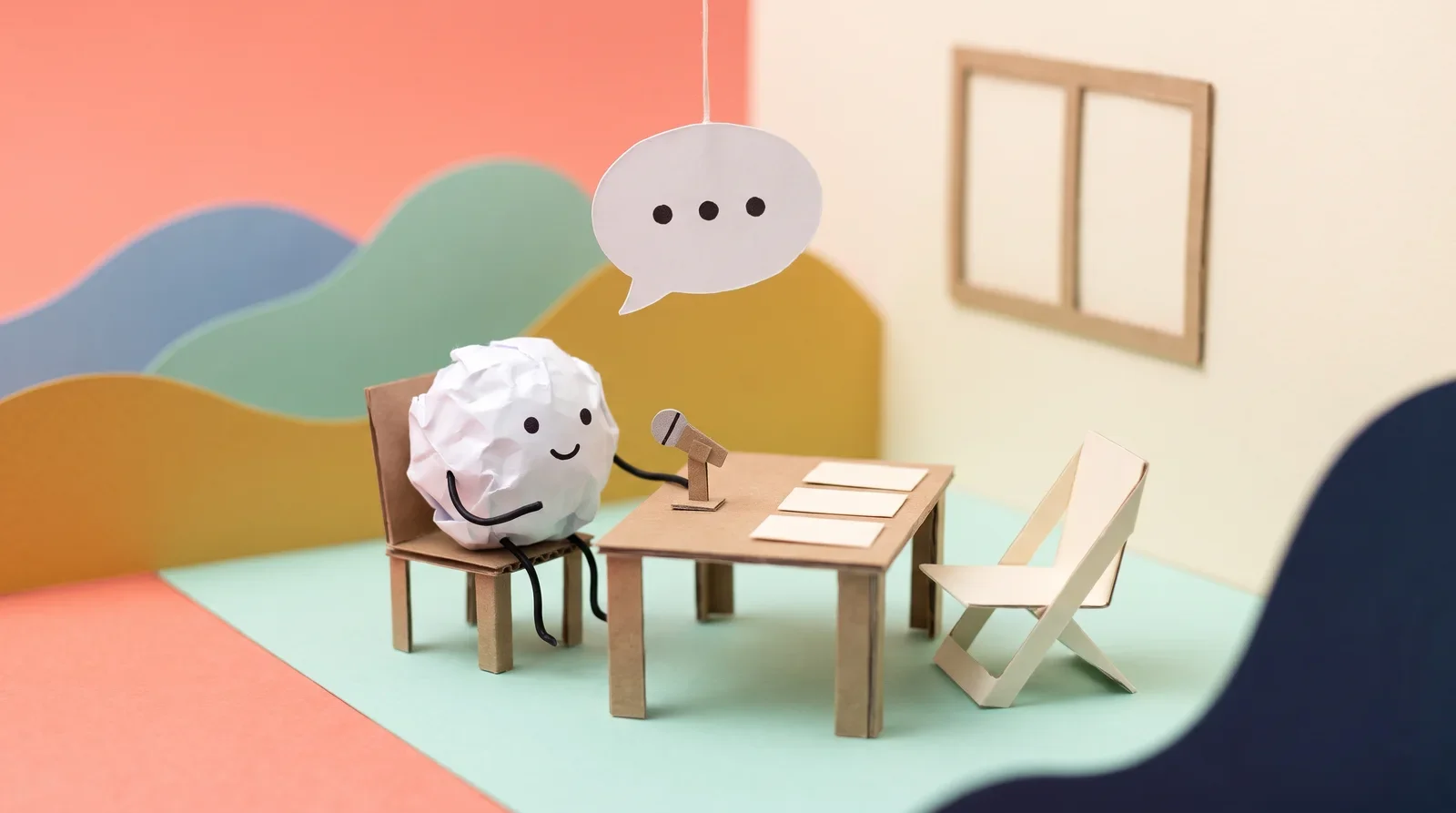
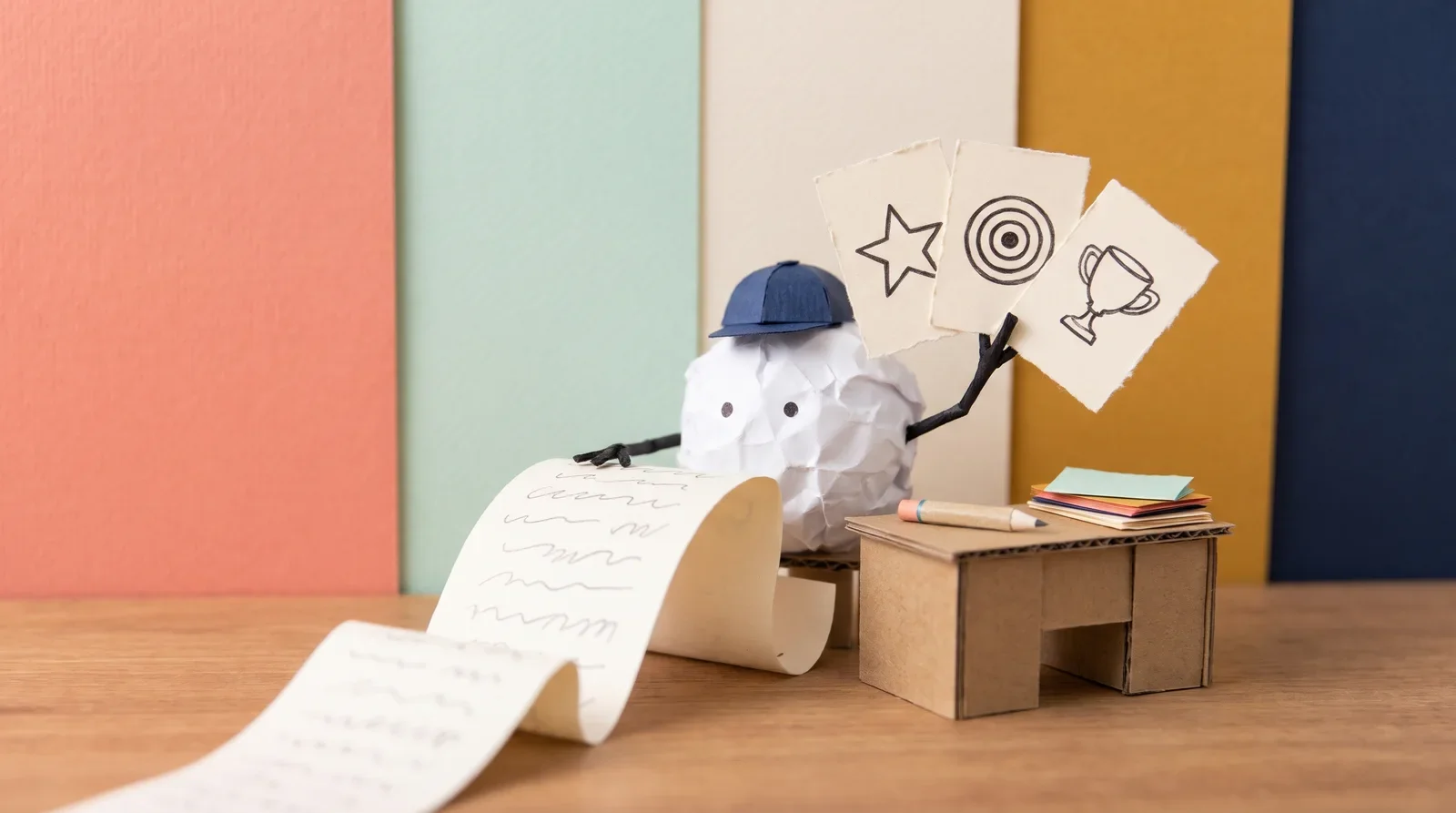
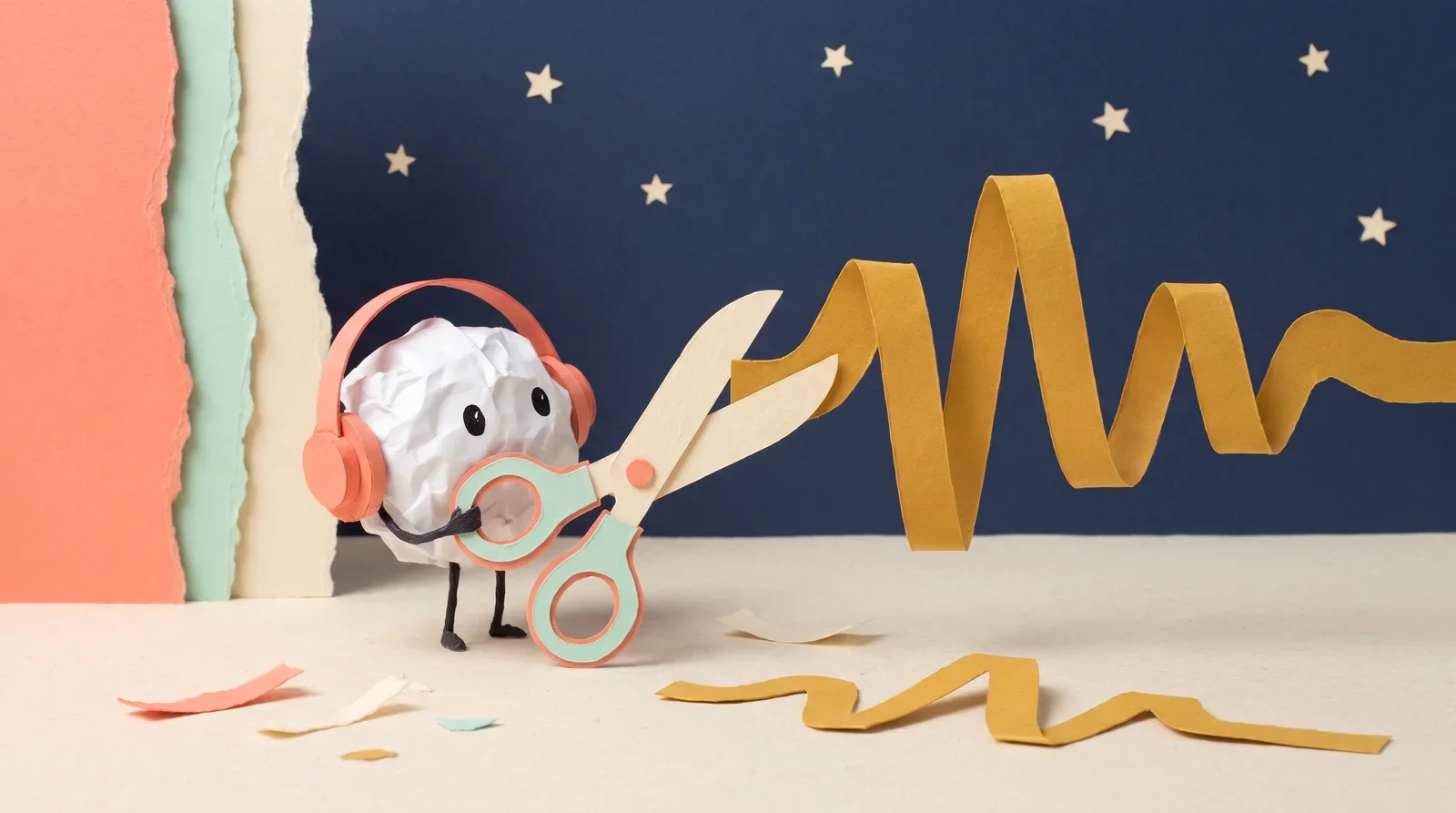
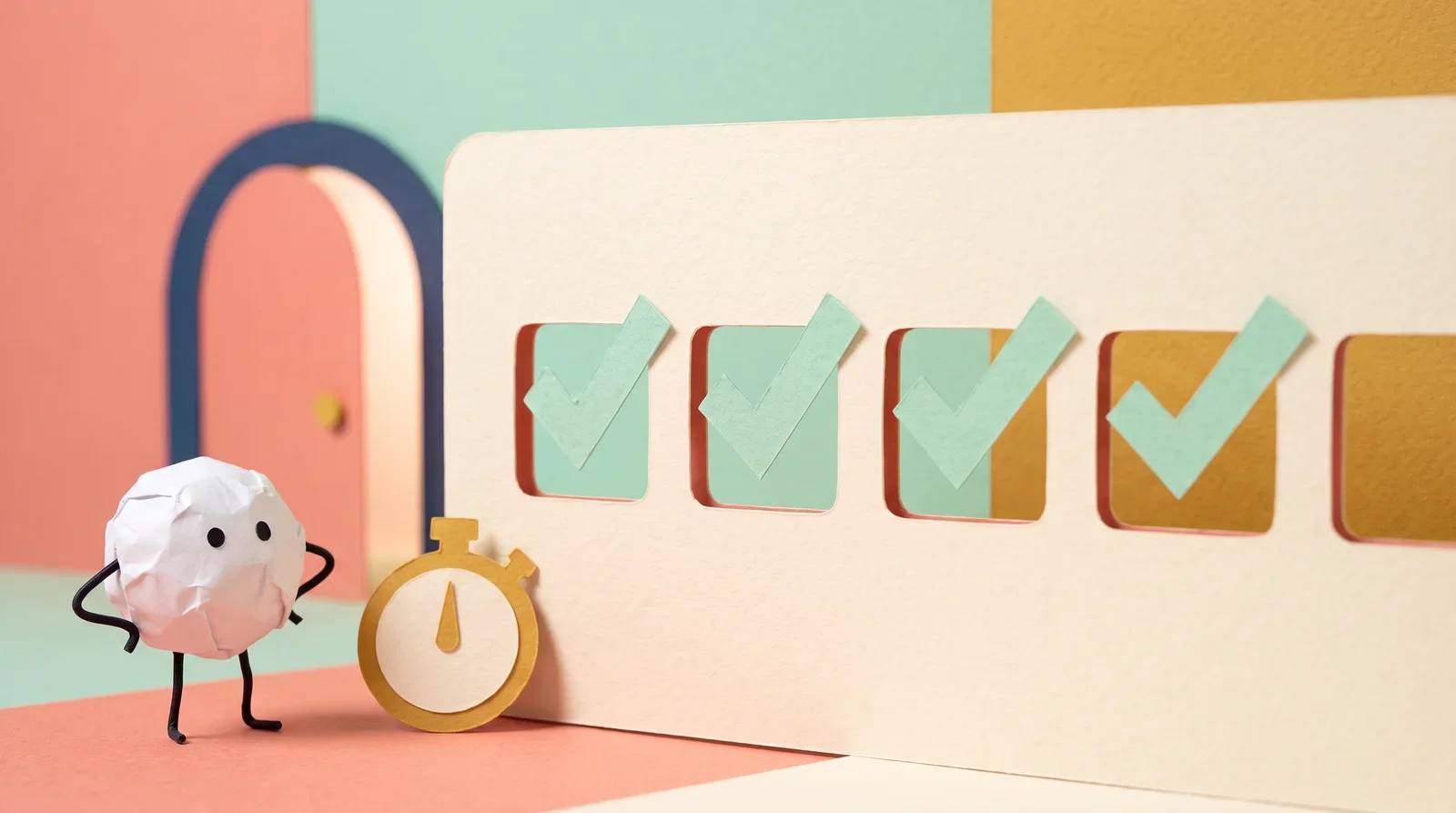
This video has no narration. Pip, the Spitball paper-ball character, sits at a small cardboard table across from an empty chair and practices answering out loud, with a speech bubble above it. Next, Pip rolls a long paper scroll of scribbles out of the way, leaving three short blank cards on a desk. Then Pip, in coral paper headphones, snips a long mustard paper sound wave shorter with paper scissors under a starry navy sky. Finally, a paper figure walks out of an open door into a room as paper confetti drifts down. Captions: Practicing for an interview on your own? Pick the questions you're most likely to be asked. Note three key points per answer, not a script. Say each answer out loud and record it. Replay it, then cut what doesn't earn its place. Record it again, then try it on a friend.
To practice for an interview by yourself, list the questions you're likely to get, note three key points for each answer, then say each answer out loud and record it. Replay the recording, cut what doesn't help, and record again. Practice from key points rather than a memorized script, and finish with one run in front of another person.
This guide is for anyone preparing for a job interview without a coach or a practice partner on hand, whether it's a first job, a promotion panel or a career change. It covers what research on interview preparation actually found, how to choose questions, how to turn a long answer into a tight one, and a four-session practice plan. Spitball is our app, so where we mention it we've kept to what it actually does.
Research claims link to the original papers; we checked each one on October 29, 2026. The practice plan, the answer lengths and the tips labeled as ours are our suggestions, built from those findings, not a tested program. Nothing here can promise a job offer.
Can you practice for an interview by yourself?
Yes. Most of what makes an answer strong, knowing your examples, organizing them and saying them clearly, can be worked on alone. What you can't get alone is a live reaction from another person, so plan to add that at the end.
The trap is practicing in your head. Reading over your notes and thinking "yes, I'd say something about that project" feels like preparation, but you only find out whether an answer holds together when you say it out loud. Halfway through a spoken answer is where you discover you don't remember the numbers, the story has no ending, or the point takes two minutes to arrive. If you want to know why speaking an idea differs from thinking it, see what the research says about thinking out loud.
Solo practice has three parts, and the rest of this guide covers each one:
- Prepare: choose the questions and note key points for each answer.
- Say it and record it: answer out loud, as if the interviewer just asked.
- Replay and cut: listen back, trim the answer, then record it again.
What does research say about practicing for interviews?
The most useful evidence comes from studies of interview coaching and preparation, mostly for structured interviews where every candidate gets the same questions. Most of the findings point the same way, but not all of them, and the exception is worth knowing.
- Preparation went with better scores. In a field study of 213 candidates for promotion into police and fire department jobs in a large city, those who attended a voluntary coaching session scored higher in a situational interview, even after the researchers accounted for job knowledge, motivation, race and sex. Candidates who also prepared in specific ways, such as study groups and role-playing, tended to score higher still (Maurer, Solamon, Andrews & Troxtel, 2001, Journal of Applied Psychology).
- Organized answers mattered. In the same study, candidates who were coached or prepared more were more likely to use strategies that organized their answers, and better-organized answers were linked to higher interview scores.
- An earlier study found a similar pattern. Across promotion procedures for four police and fire jobs, coaching attendance was linked to interview performance in three of the four, after accounting for candidates' job knowledge and motivation before coaching (Maurer, Solamon & Troxtel, 1998, Journal of Applied Psychology).
- A follow-up experiment. Later, the same research group assigned 144 participants to coaching of increasing depth before an experience-based interview, the "tell me about a time" kind. Groups given more comprehensive coaching, where the fullest level added skills training, received higher interview ratings than groups given less (Tross & Maurer, 2008, Journal of Occupational and Organizational Psychology).
- One randomized trial found no effect on offers. In an earlier field experiment, job candidates were randomly assigned either to an interview skills class (158 people) or to a self-study comparison group (140). Class members rated the training well and learned its content, but interviewers' evaluations of their interview behavior didn't differ from the self-study group's, and neither did job offers. Neither group differed from 174 candidates who didn't take part, either (Campion & Campion, 1987, Personnel Psychology). Liking a course and learning its tips, in other words, didn't show up in interviewers' ratings or in offers.
Keep the scope in mind. The promotion studies are correlational: they show who did well, not that preparing caused it, and candidates who chose to prepare may differ in other ways. The two experiments disagree, and they tested different things: deeper coaching for one structured interview format in one, a general skills class judged by real interviewers and job offers in the other. The interview studies here tested coaching programs or preparation habits. None of them tested the specific routine in this guide, recording yourself alone, so treat it as an application of these findings, not a tested result.
One more finding is reassuring if practicing feels like gaming the system. In a study of 146 public safety employees, coaching that focused on helping people get relevant content across clearly didn't undermine the interview. If anything, the interview was more reliable and more predictive in a sample of coached candidates than in a separate sample of uncoached ones (Maurer, Solamon & Lippstreu, 2008, Journal of Organizational Behavior). In that study, at least, preparing helped people show what they knew rather than cover for what they didn't.
Nerves are part of the picture too. A meta-analysis pooling many studies found that candidates who reported more interview anxiety tended to get somewhat lower interview performance ratings, an average correlation of about −.19. The link was stronger in mock interviews (about −.23) than in real ones (about −.13), and the estimate for real interviews was less certain (Powell, Stanley & Brown, 2018, Canadian Journal of Behavioural Science). That's a correlation, and it doesn't show that practicing lowers anxiety. Still, getting your answers into shape is the part of an interview you can work on.
Which interview questions should you practice?
Practice the questions you're most likely to be asked, not a list of 100. We suggest six to ten well-prepared answers. Many interview questions are variations on the same few themes, so a short list goes a long way.
Here's how we suggest building your list:
- The openers. "Tell me about yourself," "Why this role?" and "Why are you leaving your current job?" come up in some form in many interviews. For "Tell me about yourself," we suggest three parts: what you do now, one or two things from your past that led here, and why this role is the next step. Keep it to about a minute.
- The job description. Take the three or four requirements the posting stresses most and turn each into a question: "Tell me about a time you managed a deadline that slipped."
- Both question types. Interviews often mix experience-based questions ("Tell me about a time you...") with situational ones ("What would you do if..."). The studies above tested both types, so practice a few of each.
- The ones you dread. A gap in your résumé, a weakness, a project that failed. These are the answers that most need saying out loud before the day.
- Your questions for them. Have two or three ready. You'll usually be asked.
Then match a story to each question. You may find that five or six strong examples from your work, angled differently, answer most behavioral questions. Note which story goes with which question so you don't reach for the same one three times in one interview.
Should you memorize your interview answers?
No. Learn three or four key points for each answer, not a script. Memorized answers tend to sound recited, and if you lose one word of a script, it's easy to lose the whole answer.
Key points give you a structure to hang the answer on, while the exact words change a little each time. That also makes answers easier to adapt when the interviewer asks a question you prepared for in a different form. For behavioral questions, a common structure is situation, task, action and result, often called STAR. A simpler version works too:
- The point: one sentence that answers the question.
- The example: what happened and what you did, specifically.
- The result: what changed, with a number if you have one.
- The link: one sentence on why it matters for this job.
Write the key points as a few words each, not full sentences, on a card or a note. Memorize only the specific facts you'll need, such as dates, figures and names, because those are hard to make up on the spot. If you have a prepared talk to deliver in the interview, such as a presentation round, that's different: see our guide on how to memorize a speech.
How do you practice interview answers out loud?
Read the question aloud, look away from your notes, and answer as if the interviewer had just asked. Record every answer, start to finish, without stopping to restart, so you hear what an interviewer would hear.
Our suggestions for a practice session:
- Set the scene. Sit or stand as you will on the day. For a video interview, sit at the desk you'll use.
- Ask the question out loud. Hearing the question, even in your own voice, makes it feel more like the real thing than reading it.
- Answer once, all the way through. If you stumble, keep going, the way you would in the room. Restarting trains you to need a second chance you won't get.
- Record one answer per recording. Short, separate recordings are easier to replay and compare than one long session.
- Do a few, then stop. Three or four answers per session, with real attention, beats rushing through twenty.
Answering from memory is also a form of retrieval practice. In lab studies, students who practiced recalling a prose passage remembered more of it on a test a week later than students who only reread it. Rereading did better on a test five minutes later, which separate groups of students took (Roediger & Karpicke, 2006, Psychological Science). That research is about remembering material, not interview performance, but it suggests that answering from memory is a better use of practice time than rereading your notes. For more on recall, see how to remember what you read.
How do you review and cut a recorded interview answer?
Replay each recording once, all the way through, and ask one question: did the answer get to the point quickly and stay there? Then cut. First takes often run long, because it's easy to talk your way toward the point instead of starting with it.
What we suggest listening for:
- A slow start. If the first 20 seconds are background, move the answer to the front.
- The missing result. Many answers describe what happened at length and then stop. Make sure yours ends with what changed.
- Two stories in one. If you drift into a second example, pick the stronger one and save the other for a different question.
- Vague words. "We did a lot of things to improve it" is a cue to name one specific thing you did.
- "We" where the interviewer needs "I." Credit the team, then say what your part was.
- Filler words. A few are normal. If they pile up, see our guide on how to stop saying "um".
Then record the answer again with the cuts made. As a rule of thumb, which is our suggestion rather than a research finding, many behavioral answers land well at one to two minutes, and "Tell me about yourself" at about a minute. If an answer runs past two minutes, check whether the interviewer would miss anything you cut.
Keep your first take. Comparing it with your third take is the quickest way to hear what changed, and it's encouraging the night before the interview.
How do you practice speaking for an interview?
Practice the delivery separately from the content once your answers are in shape: pace, pauses and how you open and close. These are easiest to judge on a recording, because they're hard to notice while you're talking.
- Open with the answer. Your first sentence should respond to the question directly. The detail comes after.
- Take a breath before you answer. We suggest a brief pause to find your first sentence rather than starting with a ramble. Keep it short, and avoid long silences in the middle of an answer: in one study of an edited recording of a talk, a version with silence in place of each "um" was rated below the version that kept the "um"s, and a version with no gaps was rated best (Christenfeld, 1995, Journal of Nonverbal Behavior). That was one recorded talk, not an interview, so treat it as a reason to keep pauses brief, not a rule.
- Close cleanly. End on the result or the link to the job, then stop. Trailing off with "so, yeah" undercuts a good answer.
- Do one run on camera for a video interview. A voice recording shows pace and structure but not eye contact, posture or what's behind you. For a video interview, record one answer with your laptop camera, at the desk you'll use.
- Vary the order. Shuffle your questions so you practice switching between stories, as you'll have to in the room.
- Practice the follow-up. After each answer, ask yourself "What was the hardest part?" or "What would you do differently?" and answer that too.
Should you practice with another person too?
Yes, once your answers are in shape. Practicing alone gets your content ready; practicing with someone tests it against a real reaction, which no recording can give you.
There's some evidence that an audience matters for spoken practice. In a study of speech students who reported how they rehearsed, those who practiced in front of an audience received higher scores for their recorded speeches than those who practiced without one, and larger practice audiences went with higher scores (Smith & Frymier, 2006, Communication Quarterly). It's correlational and about classroom speeches, not interviews, but it's a good reason not to stop at solo practice. In the 2001 promotion study above, role-playing was one of the preparation strategies linked to higher scores.
Ask a friend to read your questions in a random order and add one follow-up of their own. Then ask them one thing only: which answer was clearest, and which one lost them?
AI practice tools are another option. Some ask you interview questions and give automated feedback on your answers; Google's interview guide, for example, suggests using Gemini Live in the Gemini mobile app to simulate a real-time, conversational interview (Grow with Google, checked October 29, 2026). We haven't tested these tools and can't say how accurate their feedback is. Whatever you use, say your answers out loud, and still do at least one run with a person.
What does a short interview practice plan look like?
Here's our suggested plan for the week before an interview, four sessions of 20 to 30 minutes each. It's built from the findings above, not a tested program.
- Session 1: Prepare. Build your list of six to ten questions, match a story to each and write three or four key points per answer. Look up any figures you'll need.
- Session 2: First takes. Record each answer once, without stopping. Don't judge yet; just get them all recorded.
- Session 3: Cut and re-record. Replay each first take, make the cuts and record it again. Spend extra time on the answers you dread.
- Session 4: Cold run. Shuffle the questions, answer without notes and record the whole set. Then do one run with another person if you can.
The day before, replay your best takes once, then put them away. Use the morning of the interview for a short warm-up: say your opening answer and one story out loud, then stop.
If you only have one evening, do sessions 1 and 3 together: note key points and record each answer twice, cutting between takes.
What can't solo interview practice do?
Practice can help you show what you know more clearly. It has limits worth being honest about.
- The studies didn't test this exact routine. The interview research above covers coaching programs and preparation habits, mostly for promotion candidates in public safety jobs. Applying it to recording yourself alone is our reasoning, not a tested result.
- Correlation isn't proof, and the experiments are mixed. In the field studies, people who chose to prepare may have differed in other ways, such as motivation or confidence. In the one randomized trial we cite that tracked real job offers, a skills class made no difference.
- Interviews vary. These studies used structured interviews with set questions. A loose conversation with a hiring manager may reward different things.
- You can't hear everything yourself. A recording shows you pace and structure, but not how a stranger reacts. That's what the run with another person is for.
- No guarantees. Preparation can help you give your best answers. Whether you get the job depends on things practice can't control, such as the other candidates and what the employer needs.
How can Spitball help you practice interview answers?
Spitball, our iPhone app for capturing thoughts, works for the record-and-replay steps. Record each answer as its own thought, up to 5 minutes long, then replay the original audio and re-record after you cut. You can start a recording in the app, or set the Action button on a compatible iPhone to Spitball's capture shortcut and press and hold it to record; see how to record a voice memo with the Action button.
Spitball doesn't give feedback, scores or AI coaching. Some interview-practice tools use AI to rate your answers; Spitball isn't one of them, so the reviewing and cutting is you. It transcribes English on your iPhone, with no cloud transcription fallback, and keeps the original audio, so you can read back where an answer wandered and search your thoughts for a word, such as the company's name. Your recordings are stored on your iPhone by default, with optional iCloud Sync using your own Apple Account, and no Spitball account is required; see the privacy page. For every way to record on iPhone, see our guide to voice notes on iPhone.
Spitball is free on the U.S. App Store for iPhone with iOS 17 or later. Get Spitball. Questions? See Spitball Support or DM Nik, Spitball's developer, at @sharma on Instagram.
A FEW MORE ANSWERS
Good questions.
How do I practice for an interview by myself?
List six to ten questions you're likely to get, match a story to each and note three or four key points per answer. Then read each question aloud, answer without notes and record it. Replay it, cut what doesn't help and record it again. Finish with one practice run in front of another person if you can.
Should I memorize answers for an interview?
No. Learn three or four key points per answer and the specific facts you'll need, such as dates and figures, but not a word-for-word script. Memorized answers tend to sound recited, and losing one word can derail the whole answer. Key points let you adapt when a question comes in a different form.
Is it good to record yourself practicing for an interview?
Yes, it's a useful way to hear what an interviewer would hear: slow starts, missing results, rambling and filler words. Replay each take once, make cuts and record again. Recording can't show you how another person reacts, so add a practice run with someone else once your answers are in shape.
How long should an interview answer be?
As a rule of thumb, which is our suggestion rather than a research finding, many behavioral answers work well at one to two minutes, and "Tell me about yourself" at about a minute. If an answer runs past two minutes, check whether you could cut background and start closer to the point.
How many times should you practice interview answers?
Enough that you can give each answer from key points without notes. We suggest recording each answer two or three times with cuts in between, across four short sessions in the week before an interview: prepare, record first takes, cut and re-record, then a cold run in random order.
Do mock interviews help?
They may, but the evidence is mixed. Among police and fire promotion candidates, coaching attendance and preparation such as role-playing went with higher interview scores, though those findings are correlational. In one experiment, groups given more comprehensive coaching received higher interview ratings than groups given less. But in a randomized trial with real interviewers, candidates who took an interview skills class got no more job offers than a self-study group. No practice method can guarantee a job offer.
Can you practice for an interview with AI?
Yes. Some tools ask you interview questions and give automated feedback on your answers; Google's interview guide, for example, suggests using Gemini Live to simulate a real-time, conversational interview. We haven't tested these tools and can't say how accurate their feedback is. Spitball doesn't do this: it records and transcribes, and the reviewing is up to you. Whatever you use, say your answers out loud, and do at least one run with a person.
Does practicing help with interview nerves?
It may help you feel more prepared, but the research we cite doesn't show that it lowers anxiety. A meta-analysis found that candidates who reported more interview anxiety tended to get somewhat lower interview ratings, with a stronger link in mock interviews than in real ones. That's a correlation, not proof that nerves caused the lower ratings or that practice fixes them. Getting your answers into shape is the part of an interview you can work on.
WRITTEN BY
Nik Sharma
Nik is an entrepreneur, active investor, and the founder of Spitball. He writes about building businesses, practical AI, and catching ideas before they disappear.